Category Archives: Women and girls

Women want governments to act on reproductive rights

Women

Few things, it seems, still make members of the international community more nervous and squeamish than discussions about sexual and reproductive health, particularly when it involves young people and especially when it concerns adolescent girls.

But if any progress is to be made when it comes to crafting the new post-2015 Sustainable Development Goals (SDGs) now under discussion, diplomats, NGOs and any other actors involved will just have to get over it, according to members of the High-Level Task Force for the International Conference on Population and Development.  

In international forums, “The issues that are often bracketed are the gender issues and, among them, the most bracketed are adolescent sexual health and rights—not among boys, but among girls,” said Dr Nafis Sadik, an obstetrician-gynecologist, veteran diplomat and special adviser on policy to the executive director ofUNAIDS, the UN agency dealing with HIV/AIDS.

Sadik spoke on a panel called “Fulfilling the Promise of Gender Equality: Women, Girls and the Post-2015 Agenda” at a side event of the 58th session of the Commission on the Status of Women (CSW58) this week.

“It always makes me wonder why policy makers don’t want girls and women to make decisions about their own bodies,” said Sadik.  “If we really want to eradicate these preventable deaths, women and girls must be able to make choices for themselves,” she said, referring to maternal mortality – 800 women per day – as a result of lack of healthcare and access to modern contraception.

“These are issues the international community needs to address squarely and not sweep under the carpet” due to cultural squeamishness, she said.

She noted that the right to reproductive health was dropped from the last set of Millennium Development Goals (MDGs).  Had that not happened, she said, “I think we’d have a different world today.”

Today’s world has an historically high number of young people and their sexual and reproductive health and rights concerns also were left out of the last MDGs, said panellist Amina Doherty, a youth advocate and member of the board of the Global Fund for Women.

That must change in the new set of SDGs, she said. “Even though we’re mobilizing, we’re here, we were invited, we see our issues are not on the agenda. We’re tired of lip service.  We’re tired of ‘youth’ being a buzzword.”

That voice is crucial for the future, said Crown Princess Mary of Denmark, a member of the High-Level Task Force for the ICPD, an independent body established in 2012 to advocate for gender equality, the empowerment of women and young people and the sexual and reproductive health and rights of all.

Acknowledging that “sexual and reproductive health and rights remain a highly controversial issue,” she noted that 16 million adolescent girls in developing countries die annually as a result of complications of pregnancy and childbirth, often as the result of early or forced marriage.  One-third of girls report that their first sexual encounter was forced on them.

“For me, it’s clear that gender equality should be a standalone goal,” said the Crown Princess on the panel.

The needs of adolescent girls were also on the mind of Michel Sidibé, executive director of UNAIDS.

He pointed out that 24 percent of young girls globally don’t know how HIV/AIDS is transmitted.  As a result, in South Africa for example, the infection rate among young men between the ages of 19 and 20 is 1 percent, compared with 16 percent for girls in the same age group.

“We will not end this epidemic if we don’t have the courage to focus on who has been left behind – women and girls,” Sidibé said.

The question, the panellists said, is whether governments have the will to make the changes that will promote gender equality and save the lives of women and girls.

“Since we know what works and what we need to do, we must just do it,” said Sadik.  “Ideology and false value systems should not stand in the way of doing the right thing.”

By Lisa Anderson

13 March 2014

Source: http://www.trust.org/item/20140313124546-9qwa1/?source=dpagehead

Africa: Women – Experts Call for Engaging Men and Boys As Allies in Fight for Gender Equality

Key Pop

Gender equality is not just a concern for women and girls, a panel of experts gathered at the United Nations in New York stressed today, highlighting the need to engage men and boys as allies and agents of change in this global struggle.


"Gender equality isn't just a women's issue. It is an issue for all. It is a rights issue because women's rights are human rights," declared Phumzile Mlambo-Ngcuka, Executive Director of the UN Entity for Gender Equality and the Empowerment of Women (UN Women), as she kicked off an event on the margins of the annual session of the Commission on the Status of Women.


"Working with men and boys, transforming masculinity and traditional perceptions of manhood must be part of the gender equality agenda," she added.


Ms. Mlambo-Ngcuka highlighted a new campaign launched by UN Women last week on the occasion of International Women's Day called #HeforShe, in which men all over the world are being encouraged to speak out against the inequalities faced by women and girls.


Speaking directly to men and boys during the launch, she called on them to take a stand, to speak out and take action for their sisters, mothers, daughters and partners. "Because silence and inaction of good men conspire against women," she stated.


Today's event, organized by Switzerland and Brazil, focused particularly on engaging men and boys to achieve the Millennium Development Goals (MDGs) – which call for the reduction of extreme poverty and other global ills by 2015 – for women and girls. MDG 3 is specifically targeted to gender equality and the empowerment of women.


"Persistent gender inequalities and discrimination of women and girls are a major obstacle to sustainable development, including poverty eradication and economic growth," said Benno Bättig, Secretary-General of the Federal Department of Foreign Affairs of Switzerland and moderator of the discussion.


MDG 3 gave women's issues some visibility, he noted, however it is silent on several key gender issues, such as violence against women and women's unequal participation in decision-making. To address not only the symptoms but the very root causes of discrimination against women and girls, Switzerland supported a stand-alone goal on gender equality and women's empowerment in the post-2015 development agenda.


"To overcome structural impediments to full gender equality, gender roles and relations must be transformed," said Mr. Bättig. "And this transformation not only concerns women and girls, it requires the active involvement of men and boys."


He added that while the engagement of men as allies has received little attention so far, it can have significant benefits for women and children, as well as for men themselves in contributing to the full achievement of all the MDGs.


The Swiss Government supports a project called "the part-time man" that promotes flexible working hours and conditions that allow men to spend more time with the family and giving women more time for their careers.


"Furthermore, our experience has shown that in societies where social norms and family honour are prevailing factors, a positive change in women's social status is only possible when men's attitudes change," Mr. Bättig stated. "We thus have to work with men and boys as strategic allies and partners to achieve gender equality."


Bafana Khumalo, of the South Africa-based gender equality organization Sonke Gender Justice, highlighted the engagement of men and boys as a means to try to limit the spread of HIV and promote women's empowerment.


He highlighted Sonke's flagship campaign, known as "One Man Can," which has proven to be an effective way to change the HIV and gender-related behaviours and attitudes of men and women. It also contributes to the decrease in the use of violence by men against women, reduces the number of sexual partners, and increases their use of condoms, testing and services.


Sonke's framework for engaging men and boys emphasizes three critical perspectives, he noted. These are involving men and boys as agents of change; engaging men and boys as equal partners; and treating men and boys as clients, so they can access and utilize services relating to their sexual and reproductive health rights.


Also highlighting the need to view men and boys as agents of change was Oswaldo Montoya from Nicaragua, the Global Coordinator for MenEngage, who also stressed the importance of offering men and boys opportunities to help them "step out of the masculinity box" and providing them with safe spaces to do so.


"I would like to propose to men and boys: forget about masculinity, embrace your humanity," he stated.


Mr. Montoya also encouraged UN Women to appoint a focal point to advance the important work being done with men and boys and to engage more of them in the pursuit of gender equality.


Antonio de Aguiar Patriota, Brazil's Ambassador to the UN, said that gender should be taken to refer to both women and girls, and men and boys. "When we discuss gender, we generally miss the reality of men and boys, their potential contribution to the empowerment of women and girls and their own gender-related specificities and vulnerabilities.


"Fully addressing all dimensions of gender inequality is a task that each and every one of us has to take very seriously – rich and poor, North and South, government and non-governmental organizations, government and private sector, men and women."


A "sobering reminder" of the comparatively unfavourable situation of women in the world, he pointed out, is that out of the 193 Member States of the UN, only 8 have women serving as President and 13 as Head of Government.


"I am convinced that it is truly revolutionary to bring men and boys on board on the discussions on overcoming gender inequality," Mr. Patriota said. "As we acknowledge that mainstream and rigid concepts of masculinity and femininity reinforce unequal and vertical power relations between men and women, we also help to accelerate progress on gender equality…


"It is time for men to join forces and enhance their role in helping to achieve a more egalitarian society. This is a win for women, a win for men and a win for our common humanity."


12 March 2014

Source: http://allafrica.com/stories/201403131528.html?viewall=1

Open Letter to African Leaders: one question for you, why do you choose to hate?

r-CAMEROON-GAY-CONVICTION-large570

Dear African Leaders,


I hope this letter finds you in good health.


I want to just say I am deeply disappointed, hurt and scared of you. I wake up every morning and I question my thoughts and views of african renaissance, I question my birth right, my ability to decide to build a family, I question relations to my family, relatives, friends, I question my ability to contribute to transformation, I question my contribution to economy, to empowerment, I question my freedom, I question my feelings and my life.


After spending so much time questioning myself, I have come to one conclusion-I chose to LOVE, love myself, love my neighbour, love my parents, love my education, love my God, love my community, love my country, love Africa, love the world, love my past, love my people, love my partner,  love my children, yes my children……I said it my children.


Do you know how I feel? Do you think you have the right to speak and decide about what I want?well till you speak to me, I will say you have no idea, all you do is hurt, hurt and hurt, and take away my freedom, let me also remind you, your take on homosexuality, on gender equality, and human rights has and continues to cost lives.

I have asked myself why? Why do you continue to hurt an African child? Why do you continue to hurt sons and daughters of the soil?is this self interest, is this power dynamics, you gamble with my life, my brothers and sisters lives?


Let me say this ………


You need to remind yourself about what demonstarting love is and what it means. True and sincere love does not insist on its rights. In the final analysis, there are two kinds of people in this world: those who lay claim to their rights and those who think about their duties; those who lay claim to their privileges and those who always think about their responsibilities; those who think that life owes them something and those who thinks that they owe life something.


People can be divided to into "grabbers" and "givers". The grabbers are those who, with clenched fists and white knuckles, constantly cling to what they regard as theirs, they are dirt poor, bankrupt in love. Mercifully, we also get givers. Those who are like the myrtle-tree on the plains that gives its lovely fragrance to the heavens, without expecting something in return.


If you were to think less about yourself interest political agenda and power, stop using me as your entry point to gaining and maintaining your power, and think more about your obligations to all in our diversity, you will be serving the world, your people, shaping the future, you will be revealing what love is, you will be revealing a revelation of true love.


All I see in you is self driven agenda of power, you have drifted from the people, from the interest of Africans. Your reluctant to reveal the true leadership qualities. You appear to be cold and introverted, you are afraid of being misunderstood, you rather make others be and feel misunderstood. This is really sad, because so many unexpressed emotions, dialogues and quality leadership views -could have enriched the world-however we remain slumbering in personalities and your personal views.


One of the characteristics of love is expressing appreciation and acknowledging others through love. It takes so little to say it loud, and yet, it brings so much joy to both giver and grabber(receiver). Love can be demostrated in a variety of practical ways. It can rise above mere sentimental emotions and enable you to make a way of life out of it, that can enrich the lives of your loved ones.


It is my experience and experiences of  others, men and women including gays, lesbians and transgender people that is filled with declared love can be fulfilling and practical. Love not hate.

African Leaders why don't you start today?


Demonstrate love for your nations that you are tasked to protect, promote and uphold, demonstrate love for your people, demostrate love for Africa, demostrate love for the world.

I stand!


Yours,

Mmapaseka Steve Letsike


This letter is written in my personal capacity. Inspired by Archbishop Desmond Tutu,  Solly Ozrovech and my mother the late Johanna K Letsike (anti-apartheid activist).


Mmapaseka Steve Letsike is with Anova Health Institute, South African National AIDS Council, National Council against Gender Based Violence and with Chapter ll.

Keep Calm: African CSO Post 2015 Coalition Advocacy Strategy Meeting.

AIDS Accountability International Africa CSO Coalition Post 2015 10AIDS Accountability International Africa CSO Coalition Post 2015 6


The International Conference on Population and Development, Commission on the Status of Women and the Post 2015 Development Agenda review processes are all important opportunities for African civil society to influence the future development agenda.


In the Africa review process of the ICPD, SDGs and CSW (that resulted in several continental positions on the post 2015 development agenda) it became clear that is civil society requires better collective organization and strategizing to perform effective advocacy. This needs to happen both at country and regional level so as to ensure the greater inclusion of Sexual Reproductive Health and Rights (SRHR) in the outcomes of these processes.


Countries will be committing to their new positions in New York (NYC) this year and the sole remaining opportunity available to civil society is to affect the position of each African country prior to their vote.


As a means to affect these country positions AAI will be leading the African CSO Post 2015 Coalition which is intended to ensure that African civil society works strategically for the best outcomes. We will thus be holding a meeting in Johannesburg in March/April (date to be confirmed) that will map out the position of countries in Africa with regard to their position on SRHR, and we will plan as a group how we can affect the outcomes in NYC.


We are looking for a particular set of people at this meeting, so if think you fit the criteria, or know someone who does, nominate them to nomvuyo@aidsaccountability.org Read more about the meeting, and the criteria click here.

A Review of Teenage Pregnancy in South Africa – Experiences of Schooling, and Knowledge and Access to Sexual & Reproductive Health Services.

ford foundation


In the past few decades South Africa has seen a decline in teenage fertility; and yet rates still remain high with around 30% of 15-19 year olds reporting having ever been pregnant, with the majority of these pregnancies being among 18 and 19 year olds. Distinguishing between whether these pregnancies are among older or younger teenagers is important as the impact for a 19 or 15 year old will be very different. Furthermore, only around one third of teenage girls return to school following childbirth. Importantly, while a large number of pregnant teenagers and 
teenage mothers are not in school, a significant proportion of girls had dropped out from school before falling pregnant. 
 
Unplanned teenage pregnancy is driven by a number of issues including: unequal gender relations; gendered expectations of boys and girls; taboos around teenage sexuality making discussions around the topic difficult and fuelling stigma towards pregnant teenagers; poor access to contraceptives; judgemental attitudes of health care workers (HCWs), teachers and community members; low rates of consistent and correct contraceptive usage, and very little dual protection to protect against both unplanned pregnancies and STIs and HIV. 
 
This report will highlight teenage pregnancy and teenage motherhood as a critical issue needing attention in South Africa. Not because teenage sexuality should be taboo, nor because teenage girls cannot and should not be mothers, but rather because a significant majority of these pregnancies are unplanned. The consequences of unplanned pregnancies can be devastating for teenage girls, and this report will show that for the majority of teenage girls unplanned pregnancy often leads to a number of negative consequences, in particular non-completion of secondary school, indeed of the one third of teenage mothers who return to school many battle to balance motherhood and schooling. And yet for teenage girls who receive support, (childcare, emotional and financial), teenage pregnancy and motherhood can sometimes be balanced with continued schooling, showing that with supportive interventions unplanned teenage pregnancy does not necessarily disrupt a girl’s future. 
 
Reducing unplanned teenage pregnancies and assisting teenage mothers to return and stay in school needs a multi-pronged response. Unplanned teenage pregnancy is not merely a reproductive health matter. Simply making more contraceptives available at clinics or schools will not necessarily reduce unplanned pregnancies. Given the multiple drivers of unplanned pregnancies the response needs to address all drivers: from the social, the structural through to 
individual behaviours, all of which can empower girls to make choices about their sexuality.


Click here to read the full document: Teenage Pregnancy in South Africa Final 10 May 2013


Malawi: Joyce Banda Forms Education Committee.

President-Banda

Blantyre — As one way of showing commitment towards the protection of a girl child in the country President Dr Joyce Banda has established a Special Committee on the Acceleration of Girls Education in Malawi.

The President disclosed this on Thursday at Sanjika Palace during an audience with High Level Task Force for Women, Girls, Gender Equality and HIV for Eastern and Southern Africa saying this committee will look at how to overcome traditional barriers to girls' education, such as early marriages and pregnancies.

The Head of State then called upon relevant authorities to hold the necessary consultations and lobbying to ensure that the country attain the right to support for the age of marriage in Malawi to be raised to at least 18 years for both boys and girls to give them time to acquire enough education before marriage.

"There is no question about my personal commitment to the raising of the marriage age. I am however aware that this is a delicate issue among some traditional leaders, conservative communities, faith leaders and some legislators.

"That is why, in my opinion, it is best that we do our homework by engaging all stakeholders and bring the bill to parliament at the right time for us to succeed," said the President Banda.

The president highlighted that there is so much that the country can achieve through working with traditional leaders who are guardians of traditional culture. She said the T/A's ability to mobilise support within their communities will be crucial in promoting and protecting girl child at a local level.

The president said she was very pleased to learn that some chiefs have already started taking big strides in promoting the girl child through the creation of a Declaration of Commitment to be signed by Paramount and Senior Chiefs.

"This declaration focuses on issues of the girl child in a holistic way, looking at education, gender-based violence, sexual and reproductive health and rights, early marriages, and HIV, while also taking advantage of the positive aspects of our culture and cultural ceremonies to support these efforts," delighted the head of state.

In her remarks leader of the High Level Task Force for Women, Girls, Gender Equality and HIV for Eastern and Southern delegation, Professor Sheila Tlou who is UNAIDS Regional Director commended President Dr Joyce Banda for her efforts in improving the welfare of the girl child education and her continued support to girls' education.

She however requested for the formation of a high level committee which will oversee the enactment of the marriage bill so that more girls should be able to complete their education before marriage.

BY YAMIKANI YAPUWA

1 NOVEMBER 2013

http://allafrica.com/stories/201311030198.html


For Millions of Adolescents, Pregnancy Can Be Dangerous.


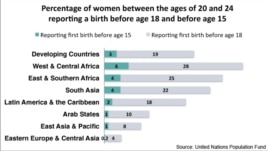
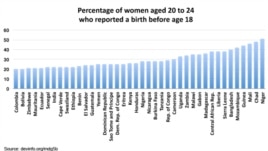
GENEVA — A new report by the United Nations Population Fund (UNFPA)finds millions of adolescent girls suffer serious long-term health and social consequences from pregnancy.  Globally, the U.N. agency estimates 7.3 million girls under 18-years-old give birth, including two million girls younger than 14.
Giving birth to a baby should be a happy moment in the life of a woman.  But, for millions of adolescents around the world, early pregnancy and childbirth results in serious health problems, social exclusion and even death.

In developing countries, 20,000 girls under 18 give birth every day, the report says.  It estimates some 70,000 adolescents in developing countries die each year from complications during pregnancy and childbirth.  Among those who survive, many will develop an obstetric fistula. This is a hole in the birth canal, which leaves the girl leaking urine constantly.

The director of the UNFPA office in Geneva, Alanna Armitage, says adolescent girls are at increased risk of child marriage and sexual coercion.  Maternal death among girls under the age of 15 from low- and middle-income countries is twice that of older females,” says Armitage.

“Our report shows that nine out of 10 pregnancies to girls under 18 take place within a marriage. And, as you may know, every day, 39,000 girls are married in violation of their basic human rights.  One in nine is married before the age of 15 and this, of course, will continue as long as families, communities and governments tolerate child marriage,” she said.

The report highlights the economic impact of adolescent pregnancy.  It notes the lifetime opportunity costs related to adolescent pregnancy range from one percent of annual GDP in China to 30 percent of annual GDP in Uganda.

To drive this point home, the report notes $3.4 billion could have been added to the Kenyan economy had the more than 200,000 adolescent mothers in the country been employed rather than pregnant.

The report finds in every region of the world, impoverished, poorly educated rural girls are more likely to become pregnant than those who live in richer, more urban areas.  UNFPA Senior Maternal Health Advisor Luc de Bernis says the highest rates of adolescent maternal mortality are found in Sub-Saharan Africa and South Asia.

He says the problem is marginally greater in the Francophone than the English-speaking African countries.

“Africa is not homogeneous and we have many differences, but the fact is young girls are not protected in the majority of these countries — not in the Francophone for sure…and not in the English speaking world,” said Bernis. “In Kenya, Uganda, you have a rate of abortion which is absolutely enormous and it explains a big part of the maternal mortality.  A big number of these abortions occur among very young girls.”

The report says adolescent pregnancy is a much bigger challenge in the developing world than in developed countries.  But it finds that adolescent pregnancy is still a significant issue in the richer nations.

It says blaming a young girl for getting pregnant is counter-productive.  Instead of changing the girl’s behavior, the report says, society should change its attitudes and actions.

Among the recommendations for reducing adolescent pregnancy with its related risks, the report suggests keeping girls in school, stopping child marriage, and providing adolescents with access to sexual and reproductive health, including contraception.

By Lisa Schlein

30 October 2013

http://www.voanews.com/content/pregnancy-dangerous-for-millions-of-adolescents/1780067.html

Women’s health communities critical to reducing maternal and child mortality in Africa.

Obstetricians and gynecologists, ministers, public health specialists and civil society organizations convened in Addis Ababa, Ethiopia from 2-5 October at the First International Federation of Gynecology and Obstetrics (FIGO) Africa Regional Conference to discuss ways of improving maternal and child health in Africa.

Speaking at the opening, UNAIDS Deputy Executive Director, Programme, Luiz Loures highlighted the link between HIV and maternal and child health. He called for women’s health and HIV communities to closely work together to increase access to life-saving health services to reach the most marginalized in society.  He also stressed the need to uphold the sexual and reproductive rights of women living with HIV.

In sub-Saharan Africa, women are more likely to be living with HIV than men, accounting for 58% of the 22.1 million adults who were living with HIV in the region in 2012. Young women are particularly at risk of HIV infection–– around 28% of all new adult HIV infections in sub-Saharan Africa are among young women between the ages of 15-24. HIV is also a leading cause of death among women of reproductive age and has a major impact on child health and mortality, mainly through the transmission of HIV from mother to child.

Dr Loures congratulated FIGO on its visionary and bold work on women’s sexual and reproductive rights. He also underscored UNAIDS commitment to strengthening its collaboration with FIGO to raise political visibility and engage women’s networks on HIV and sexual and reproductive rights issues to reduce AIDS related maternal and child mortality.

Quotable

Human rights must be at the centre of our practice as everyone has a right to live. Our primary commitment as physicians is to save lives.

Luiz Loures, UNAIDS Deputy Executive Director, Programme

FIGO looks forward to active collaboration with UNAIDS to ensure the protection of the rights of women living with HIV regarding access to their services in the health sector.

Professor Professor Sir Sabaratnam Arulkumaran, FIGO President

Ethiopia has made excellent progress towards achieving the millennium development goals on maternal and child health and we are grateful for the assistance from our partners, such as FIGO and UNAIDS.

Dr Amir Amare, State Minister at the Federal Ministry of Health – Ethiopia

Are you in(volved)?

African Women MPs Discuss Family Planning

Kampala — African women MPs and leaders want parents to allow their teenage daughters to access family planning and reproductive health services with a view of bringing down the increasing cases of early and unwanted pregnancies, risky abortions and maternal deaths.

The women leaders on a two-day capacity building meeting that opened on Sunday at Speke Resort Munyonyo discussed ways on how they can reposition family planning and reproductive health on the development agenda of their respective government budgets.

The meeting was organized by Partners in Population and Development Africa Regional Office (PPDARO) in collaboration with the Health Policy Project and drew participants from Ethiopia, Malawi, Ghana and Uganda the host.

Former Kalangala district Woman MP, Ruth Nvumetta Kavuma, who is a member of the African Women Leaders’ Network said that one of the major objectives of the meeting is to ensure leaders push issues of family planning and reproductive health in their countries to get increased funding.

Increased funding, she pointed out, would be key in lowering the infant and maternal mortality rates and make family planning services accessible to all women.

Amid such efforts, most parents, especially mothers still carry a negative attitude of family planning and reproductive health to their teenage daughters, said Kavuma.

And the mindset is that some mothers think that by letting their teenage daughters to access family planning services, it would lead them into promiscuity.

“But parents ought to explain all issues around family planning and reproductive health to their teenage girls so that they are aware of the outcomes of any activity they might desire to involve themselves in, including early sex,” she said.

The former lawmaker underscored the need for parents to let their teenage daughters access family planning contraceptives because of the potential of early exposure to sexual activity.

“We want parents to allow the teenage girls to attend family planning meetings at various health facilities so that they can access information and services that can help them to avoid early sex and pregnancies and how to deal with all issues around reproductive health.”

Dr. Jotham Musinguzi, the PPDARO director said there is need for African governments to increase funding towards family planning services.

He said, in Uganda for example, at least 34% of couples desire to have family planning services to space their births but cannot access them.

He went on to stress that efforts should be made to ensure this portion can have voluntary family planning services.

“If women can access voluntary family planning services, they will avoid risky and unwanted pregnancies and deaths, leading to spaced births that will be reflected in other sectors like gainful employment,” he said.

He explained that although Uganda has seen increased funding towards family planning in the last four years, there is still need to improve on policies that can benefit the grassroots women to access better health services.

Ellen Thokon Solomon from the Malawian parliament said many teenage girls in her country who became mothers disclosed that they had never received any information regarding family planning and therefore lacked knowledge on how to avoid early pregnancies.

Other young mothers in Malawi say, according to Solomon, that they would want to use family planning methods but cannot access the services or are not aware of facilities where they are available.

She therefore appealed for increased funding so that these services could be available to all women at the various lower health faculties.

By Eddie Ssejjoba

17 September 2013

http://allafrica.com/stories/201309171114.html?viewall=1


Are you in(cluded)?

Failure to include reproductive health for women as a priority affects sub-Saharan African economies, expert says

Failure for Sub-Saharan African countries to work towards achieving Millennium Development Goals on health will impact all other aspects of development including economic growth, Akatsa Bukachi, Director, Eastern Africa Sub-region Support Initiative for the Advancement of women (EASSI) has said.

Speaking to Africa Science News in Busia town, Bukachi said the Sub-Saharan Africa region is deficient in areas of reproductive health that is crucial for addressing the MDG on Children and maternal in health. Bukachi observed that reproductive health is fundamental in the advancement of women and girl child in Africa.

She noted that the African continent will only achieve its MDG on health if proper incentives to improve family planning, reduce maternal mortality and prevent HIV/Aids infections are prioritized. Family planning as a strong component of better reproductive health has steadily declined in the recent years in sub-Saharan Africa but it needs to be prioritised.

In the last 10 years, Sub-Saharan Africa region still grapples with the highest number of maternal mortality ratio of 500 maternal deaths in 100,000 lives.

Bukachi said that despite most countries in the region boasting that the number of women dying as a result of pregnancy and child birth-related complications has declined to 47 percent from more than 543,000 to 287,000 cases globally has been registered, nonetheless, the war against maternal mortality especially is far from over. She called for synergy to advocate for a strong pillar in reproductive health agenda.

The Director disclosed that reproductive health challenges are huge and women should take their positions in addressing the problems.

The Eastern Africa Sub-region Support Initiative for the Advancement of women is on the front to advocate for a complete diet and women girl child health situation in Eastern Africa Region.

In most cases in Africa continent, nutrition has always played out in the rising statistics of maternal mortality ratio in Sub-Saharan Africa.

The organisation operates in eight Eastern Africa Countries namely Kenya, Uganda, Tanzania and Somalia. Other countries in clued; Ethiopia, Rwanda, Eritrea and Burundi.

By Cheki Abuje

http://www.africasciencenews.org/en/index.php?option=com_content&view=article&id=940:poor-reproductive-health-to-affect-sub-saharan-african-economies-expert-says&catid=63:health&Itemid=114