Category Archives: Sexual Orientation

South Africa, Which Once Led On Promoting LGBT Rights Abroad, Could Become A Roadblock
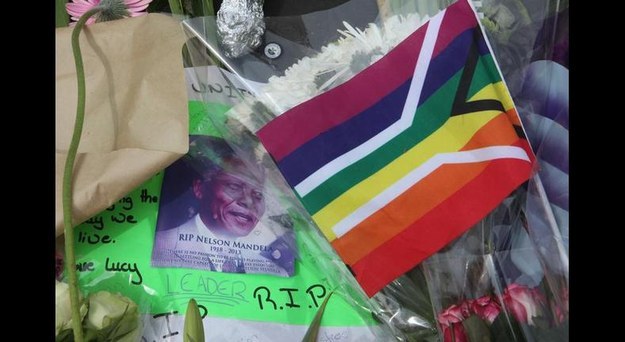
SA mandela LGBTI Ntsoaki NhlapoAdvocates fear South Africa might turn against an LGBT rights resolution at the UN that it sponsored three years ago.

South Africa was once the essential nation to advancing LGBTI rights in international diplomacy. Now it has become a potential roadblock.

Back in 2011, South Africa sponsored a resolution before the United Nations Human Rights Council (HRC) that, for the first time, recognized LGBTI rights as human rights. Other nations, especially from Latin America, had been working to advance LGBTI rights in less high-profile ways for several years before, but South Africa’s leadership was critical to taking the effort to the level of a formal resolution. Such a proposal had to have at least one prominent African backer, its supporters believed. Otherwise, it would play into the hands of LGBTI rights opponents in Africa and other parts of the world that had once been colonized who argue that homosexuality was a Western perversion brought by colonial powers.

An updated version of the resolution was tabled Thursday at a Human Rights Council meeting underway in Geneva. It was sponsored by Brazil, Colombia, Chile, and Uruguay. A vote is expected next week.

Not only is South Africa’s name not on it, but some LGBTI rights supporters tell BuzzFeed News that South Africa’s diplomats are behaving so strangely in negotiations that they worry the country could even turn against the resolution. A South African defection might not only help torpedo the proposal, it would also be a stunning symbolic reversal for a country that set the standard for protecting LGBTI rights. When South Africa adopted its first post-apartheid constitution in 1993, it became the world’s first nation to protect LGBTI rights in its fundamental rights declaration. This came out of a commitment to fighting a broad range of oppression, and it commanded even greater moral authority because it was rooted in the experience of fighting white supremacy.

So some LGBTI rights supporters are looking at South Africa’s reluctance to clearly support the new resolution as a fundamental betrayal.

“We currently have leadership that fails to represent the ethos of what the constitution says and the equality principles they have to uphold,” said Mmapeseka Steve Letsike, a lesbian activist who chairs the South African National AIDS Council’s Civil Society Forum. “We have leadership going out of this country putting their personal beliefs before its own people. We have leaders that fail to protect their own.”

South Africa’s pullback on LGBTI rights internationally comes as homophobia has become an increasingly common political tool across Africa, framed as a form of standing up to the West. Nigeria and Uganda both passed sweeping bills criminalizing LGBTI rights advocacy this winter, the governments of The Gambia and Chad both have pending proposals to stiffen laws against homosexuality, and LGBTI people are being targeted by police from Zimbabwe to Egypt to Senegal.

“Silence in the context of the African Bloc suggests a kind of complicity with the homophobic rhetoric,” said Graeme Reid, a South African who directs Human Rights Watch’s LGBT program. “It speaks of a kind of misplaced solidarity … not aligning with the [LGBTI] people who are the victims of human rights abuse, but with the perpetrators under the rhetoric of supporting our ‘African brothers and sisters.’”

LGBTI rights supporters were also hopeful that some smaller African countries could be persuaded to abstain on the vote — a kind of soft yes — and one or two might even be convinced to back it. This could tip the balance if the vote is close. The 2011 resolution was a nail-biter, passing 23-19 with three abstentions. But that becomes very hard if South Africa can’t counterbalance conservative continental heavyweights that might be lobbying the smaller countries.

“As soon as [South Africa] pulls back, it gives countries like Nigeria and Egypt room to bully and push the smaller countries,” said an LGBTI rights advocate from another southern African country who asked to speak anonymously in order to avoid a backlash in negotiations. “We need South Africa to maintain the same position if not better” than in 2011.
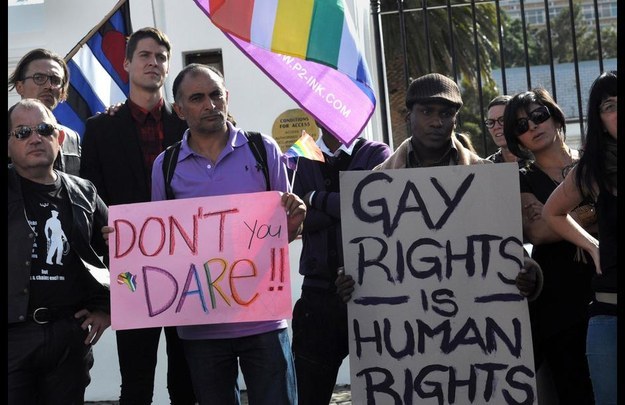
gay rights is humn rights

It’s hard to see why this resolution is so important by reading the plain language — all it really does is order a bi-annual study of LGBTI rights by the United Nations High Commissioner for Human Rights. But there are only a few places where language referring to LGBTI rights exists in any international agreements. This small resolution is a way of giving U.N. staff authority to work on LGBTI issues and means that it will be a regular focus of discussion in Geneva. And it will be a precedent that can be used to broaden the inclusion of LGBTI rights in other human rights agreements.

Most LGBTI rights supporters came into the negotiations that began last week assuming that South Africa would be supportive even if it no longer wanted its name on the resolution. Regional coalitions are very important in the U.N., and other major powers within the Africa bloc, especially Nigeria and Egypt, have been at the forefront of pushing anti-LGBTI policies. South Africa had taken a lot of heat for the 2011 resolution, and many LGBTI supporters might have understood if officials chose not to take a public role in support this year.

But they’ve withheld their support even in private discussions, say sources familiar with the negotiations. The head of South Africa’s Geneva delegation, Ambassador Abdul Samad Minty, took the unusual step of coming personally to an informal meeting on Wednesday, something usually left to staff. But he said virtually nothing in the meeting, said a source in the room, which showed other nations that South Africa isn’t about to go to bat for the proposal.

This posture follows a move by South Africa’s ruling African National Congress party to block a parliamentary motion to condemn anti-LGBTI legislation enacted by Uganda in February (which has since been struck down by the court). It also comes after a vote by South Africa during the June HRC session that stunned LGBTI rights supporters: South Africa joined with conservative nations on a procedural vote to exclude a sentence stating “various forms of the family exist” in an Egyptian-led resolution on the “Protection of the Family.” The resolution passed without this language, and LGBTI rights supporters were concerned that the language could be used as precedent for excluding families from protections under international law if they are not led by a heterosexual couple.

“In the room they’re being a little bit weird,” said a diplomat from a Western country working on the resolution, referring to South Africa’s behavior in the negotiations. But this isn’t entirely new. “They’ve been behaving weird for two or three years on this,” the diplomat said.

The diplomat attributed that more to a change in personnel than an intentional shift in policy: Jerry Matjila, who was South Africa’s ambassador to the Human Rights Council when work began on the 2011 resolution, has since returned to Pretoria to take a senior post in the Department of International Relations and Co-operation. His replacement, Ambassador Minty, lacks his personal commitment to the issue, say sources who have worked with the delegation.

South Africa’s Geneva mission and the Department of International Relations and Co-operation in Pretoria did not respond to requests for comment.

But some South African activists see this dilution of South Africa’s commitment to LGBTI rights internationally as part of a larger trend in the country’s leadership. The late Nelson Mandela and other leaders of the African National Congress embraced LGBTI rights as part of a commitment to fighting a broad range of oppression as they brought South Africa out of apartheid — Matjila is seen as part of that school. But that commitment is not as strong among the younger generation of leaders, most notably President Jacob Zuma, who called same-sex marriage “a disgrace to the nation and to God” around the time the unions won legal recognition in the country.

The shift doesn’t mean South Africa has done a 180 on LGBTI rights. Rather, it’s led to a kind of schizophrenia that is frustrating to LGBTI rights supporters. The lack of support for this resolution is all the more confusing because it comes at a time that there is a new commitment from the government to fighting anti-LGBTI hate crimes inside the country, spurred by a series of horrific rapes and murders of black lesbians.

“Domestically, there is a sense of a real commitment and energy and political will,” said Human Rights Watch’s Graeme Reid. But the international stance is incoherent — the Latin Americans only introduced the resolution at the last minute because South Africa wouldn’t let go of its ownership of the issue until just before the Human Rights Council session began earlier this month.

“There is an air of uncertainty about their position because they have been dragging their feet on this for the last three years, not moving on the resolution and not dropping it,” Reid said.

The resolution’s supporters are optimistic that they will have the votes to pass the resolution if it gets an up or down vote next week, and no one who spoke to BuzzFeed News for this story said they thought it was possible that South Africa would vote against the resolution on the final vote. It could abstain on a final vote, a possibility that some of the resolution’s supporters fear is more likely as the negotiations wear on. Or it could vote for a procedural motion that would kill the resolution by denying an up or down vote — exactly what it did to keep the inclusive language out of the Protection of the Family resolution in June.

“It would be unacceptable, incomprehensible, and almost unconscionable for a relatively new democracy like South Africa to support shutting down debate at the UN’s human rights body [to affirm a principle] that’s in its own constitution,” said Marianne Møllman, program director of the International Gay and Lesbian Human Rights Commission, in an interview from Geneva.

draft resolution

By J. Lester Feer

Source: http://www.buzzfeed.com/lesterfeder/south-africa-which-once-led-on-promoting-lgbt-rights-abroad?utm_term=9vaowf#2dmkbjy

Leaving no one behind in the post-2015 development agenda: young marginalized people claim their space

missionbrazil_632The sexual and reproductive health rights of young marginalized populations are often neglected and their collective voice in this critical area not always heard. To try to redress this imbalance young people from marginalized communities and key populations in Bangladesh, Ethiopia, Puerto Rico and Uganda met in New York this week to discuss how to put these rights issues firmly on the post-2015 development agenda, leaving no one behind. 


Taking place on 25 September, the General Assembly side event which took the form of a panel discussion, examined the vital role of community engagement, advocacy and service delivery in protecting the rights and meeting the needs of young key populations. These include men who have sex with men, sex workers and young people living with HIV.   


Young speakers, who were peer educators, directors of national and regional NGOs, actors and community leaders, argued that universal access to HIV services and health coverage could not be achieved without prioritizing the needs of the most marginalized. They also noted the contribution of comprehensive sexuality education to improving young people’s health and the role that communities can play in both promoting rights and challenging stigma and discrimination.


The event was hosted by the Government of Brazil and organized by the International HIV/AIDS Alliance, GESTOS, the Global Youth Coalition on AIDS, ATHENA, ICASO, International Civil Society Support, STOP AIDS NOW!, Stop AIDS Alliance, the HIV Young Leaders Fund, the African Services Committee, and the Global Forum on MSM and HIV, in collaboration with UNAIDS.


Quotes

"Setting goals is only part of the story. Where we should look for change is the way that we will implement the goals. We need to change the way we are doing business and craft the space for civil society in the new post-2015 agenda."

Luiz Loures, UNAIDS Deputy Executive Director


“We are talking about development here and sexual and reproductive rights are development."

Pablo Aguilera, HIV Young Leaders Fund


By UNAIDS

26 September 2014

Source: http://www.unaids.org/en/resources/presscentre/featurestories/2014/september/20140925csyoungpops/

We Can’t Have a Post-2015 Agenda Without SRHR

In 2000, the creators of the Millennium Development Goals (MDGs) completely overlooked sexual and reproductive health and rights (SRHR), a mistake that, if repeated, would cripple the dreams of millions of young girls and women for years and generations to come.


Access to SRHR enables individuals to choose whether, when, and with whom to engage in sexual activity; to choose whether and when to have children; and to access the information and means to do so. To some, these rights may be considered an everyday reality. However, that is not the case for millions of young people in the world – particularly girls and women.


On Tuesday night, I had the fantastic opportunity to listen to some of the foremost global leaders speak on behalf of ensuring access to sexual and reproductive health and rights in the post-2015 agenda. The benefits of ensuring SRHR are society wide and inevitably translate into improved education, economic growth, health, gender equality, and even environment.

15151254527_adb1d98efd_k

Education


“At my high school, you would be expelled if found with a condom.” – Samuel Kissi, former President, Curious Minds Ghana


When girls are healthy and their rights are fulfilled, they have the opportunity to attend school, learn life skills, and grow into empowered young women. Wherever girls’ SRHR are ignored, major educational barriers follow. Child marriage and early pregnancy are major contributors to school dropout rates. In South Asia and Sub-Saharan Africa, girls are married before age 18 at an alarming 50 percent and 40 percent respectively. And in Sub-Saharan Africa, where 90 percent of adolescent pregnancies occur in marriage, it is safe to assume that not all those sexual acts were consensual and not all those pregnancies were planned.


Economic Benefits


“Initially I used to oppose family planning, but now I fully support. I support it because my wife has more time to work and earn money.” – The Honorable Dr. Tedros Adhanom Ghebreyesus, Minster of Foreign Affairs for the Federal Democratic Republic of Ethiopia, sharing the story of an Ethiopian man’s changed opinion regarding the importance of SRHR


Protecting SRHR not only saves lives and empowers people, but it also leads to significant economic gains for individuals and for the community as a whole. As previously stated, ensuring SRHR helps to decrease school dropout rates and, as a result, leads to a more productive and healthy workforce as each additional year of schooling for girls increases their employment opportunities and future earnings by nearly 10 percent.


Broader Health Agenda


“We cannot eliminate new HIV infections without providing SRHR services to women so they can make informed decisions to protect themselves and their children in the future. Yes, we will end the AIDS epidemic, but first we need to respect the dignity and the equality of women and young girls.” – Dr. Luiz Loures, Deputy Executive Director, UNAIDS


Access to SRHR guarantees quality family planning services, counseling and health information. These services are critical, particularly because women are often victims of gender-based violence and sexual assault and thereby face greater risks for sexually transmitted diseases like HIV/AIDS. Failing to secure and uphold SRHR dooms women and girls with an increased risk of unsafe, non-consensual sex and maternal mortality.


Gender Equality


“How can you control your life if you cannot control your fertility?” – Helen Clark, UNDP Administrator


When a woman can easily plan her family, she is more equipped to participate in the economy alongside her male colleagues. When the sexual rights of a woman or girl are fulfilled, she will experience decreased rates of sexual violence and enjoy a healthy relationship with a respectful partner. When a woman or girl does not fall victim to child marriage and early pregnancy, she can stay in school and achieve anything she puts her mind to.


Environment


“The woman continues to bring life, to bring up the next generation, to stand before you and say, ‘I am ready to embrace my rights and to deliver a better planet to humanity.’” – Joy Phumaphi, former Minister of Health, Botswana; Chair, Global Leaders Council for Reproductive Health

15151200248_776fc50801_k

A 2012 study found that community water and sanitation projects designed and run by women are more sustainable and effective than those that are not. Similarly, women produce 60 to 80 percent of food in developing countries and, with the economic and educational gains that coincide with secured SRHR, a woman is better equipped to effectively manage her land.


The post-2015 Sustainable Development Goals will not happen without SRHR being addressed. So far, the world has failed to recognize that SRHR are equally as fundamental to global development as finance and trade. We can no longer afford to view SRHR as a taboo or promiscuous topic. When 90% of first births in low-income countries are to girls under 18; when the leading cause of death among adolescent girls aged 15 to 19 is pregnancy and childbirth; when two-thirds of new HIV infections in sub-Saharan Africa are among adolescent girls; and when 200 million women want to use family planning methods but lack access, the young girls and women of the world do not have a promiscuity problem – they have a human rights problem.


By Elisabeth Epstein

25 September 2014

Source: http://girlsglobe.org/2014/09/25/we-cant-have-a-post-2015-agenda-without-srhr/

The UNHRC Votes Yes! for Sexual Orientation and Gender Identity

African civil society celebrates the continued recognition of sexual orientation and gender identity at the United Nations Human Rights Council


For Immediate Release


29 September 2014


African Men for Sexual Health and Rights [AMSHeR], the Coalition of African Lesbians [CAL], and the Demand Accountability SA Campaign* recognise the adoption of a resolution, led by Chile, Uruguay, Columbia and Brazil – on “Human Rights, Sexual Orientation and Gender Identity” Resolution L27 –at the United Nations Human Rights Council in Geneva. 25 States, including South Africa, voted in favour of the resolution, 14 States voted against it, and 7 States abstained from voting. One State was absent during the vote. 


In 2011 South Africa, with co-sponsorship from Brazil and Norway, led a Resolution [17/19] on Human Rights, Sexual Orientation and Gender Identity which was adopted at the Council in June 2011. Its adoption led to the first official United Nations report (A/HRC/19/41) titled Report of the HC – Study documenting discriminatory laws and practices and acts of violence against individuals based on their sexual orientation and gender identity by the Office of the High Commissioner for Human Rights). This Resolution was voted for by 23 to 19 States, with three abstentions, indicating their recognition of sexual orientation and gender identity as a human rights issue and denouncing violence and discrimination on these grounds. 


More than three years after Resolution 17/19, the oppression of people of non-conforming sexual orientation and gender identity and expression has worsened all over world. In Africa, intolerance against people who engage in same sex relations, those who are gender non-conforming, intersex people and those who identify as lesbian, gay, bisexual and trans-diverse has manifested in the form of retrogressive legislation that seeks to limit the rights and freedoms of many African people. Such legislation has been introduced in Nigeria and Uganda and moves are underway in Gambia and Chad to do the same. 


Phillipa Tucker of AIDS Accountability International asserted that states have an obligation to protect human rights for all and cannot allow violence and discrimination against anyone to be justified and excused.  Other activists slated the use of religion and tradition to deny all people the right to peace and safety. “We will not accept states imposing their own religious beliefs on others. We insist on the rights of everyone to freedom of belief and religion and at the same time will not sit back and watch states impose the religious beliefs on those who hold opposing beliefs”, according to  Ingrid Lynch from Triangle Project. 


Kene Esom of African Men for Sexual Health and Rights stated that “The levels of violence and discrimination in Africa are of particular concern to our organisations and African states must fulfil their obligations to stop all forms of violence and this includes violence based on real or perceived sexual orientation and gender identity and expression. In April this year, the African Commission on Human and Peoples Rights adopted the first ever Resolution focussed on sexual orientation and gender identity within the African human rights system calling on states to end the violence. This Resolution and the Resolution adopted today at the Human Rights Council all contribute to a shift in the culture of impunity when it comes to the human rights of people who are non-conforming in terms of sexual orientation and gender identity”. 


The vote by African states included a yes vote from South Africa, four abstentions from Burkina Faso, Congo, Namibia and Sierra Leone; with Algeria, Botswana, Cote D’Ivoire, Ethiopia, Gabon and Kenya all voting against the Resolution.  In a not unexpected backlash, the Organization of Islamic Conference (OIC), represented by Pakistan, as well as Bahrain, Congo, Djibouti, Egypt, Malaysia, Namibia, Sierra Leone, South Sudan and the United Arab Emirates, proposed amendments to the Resolution, intended to weaken the provisions of the Resolution and to remove direct reference to sexual orientation and gender identity. Namibia withdrew their co-sponsorship of these troubling proposed amendments before they came to the vote. The amendments were all defeated.  “Collectively, the defeat of the proposed amendments, the growing number of abstentions since June 2011 and the explanation of the vote by Botswana are all seen as small steps forward. These shifts are understood to come out of strengthening behind the scenes and more public dialogue emerging from, as an example, the Universal Periodic Review [UPR] of all state as well as strong and effective campaigning by civil society in these countries and in intergovernmental spaces” was the view of Sally Shackleton from Sex Workers Education and Advocacy Taskforce [SWEAT]. “We must collectively now invest more heavily and responsibly in national level organising and building civil society capability to step up and sustain the work at the national level, even as we intensify our work within the international human rights system” was the position of Shacketon.


Activists in Africa now look forward to the South African government, through the Department of International Relations and Cooperation [DIRCO], hosting the long awaited seminar ‘Ending Violence based on Sexual Orientation and Gender Identity and Expression in Africa’. This Regional Seminar is a critical step in creating space for dialogue on rights related to sexual orientation and gender identity in the African region. South Africa must fulfil its commitment in this regard. 


*Members of the Demand Accountability Campaign: 
 
1.    AIDS Accountability International
2.    Access Chapter 2
3.    African Men for Sexual and Reproductive Health and Rights
4.    African Sex Workers Association
5.    Coalition of African Lesbians
6.    Durban Gay and Lesbian Centre
7.    Forum for the Empowerment of Women
8.    Gay and Lesbian Memory in Action
9.    One in Nine Campaign
10.    People Opposing Women Abuse
11.    Sex Workers Education and Advocacy Taskforce
12.    Sonke Gender Justice
13.    South African National AIDS Council – Civil Society Forum
14.    Triangle Project


For comments please contact: 
 
•    Dawn Cavanagh
Coalition of African Lesbians [CAL]
Email: dawn@cal.org.za 
Tel: +27 71 104 1718


•    Kene Esom
African Men for Sexual Health & Rights [AMSHeR]
Email: kene@amsher.net 
Tel: +2711 242 6801 [Direct] or +2711 482 9201


SIGN ON CALL FOR SOUTH AFRICA TO TAKE LEADERSHIP IN SAFEGUARDING SOGI RIGHTS AT THE HUMAN RIGHTS COUNCIL

Demand Accountability Profile Image Ntsoaki

As you may know this is the last week of the 27th ordinary session of the United Nations Human Rights Council (UNHRC)for 2014 taking place in Geneva, Switzerland.


This is an important session and with huge implications for SOGI work and SOGI activists. Chile, Uruguay, Colombia and Brazil have tabled a follow up SOGI Resolution 27/L27 to Resolution 17/19 of 2011. This resolution seeks to affirm state’s commitments to safeguarding the rights and freedoms of African people with non-conforming sexualities and gender identities and expressions.


This week, some states seek to amend the language in this resolution, which will attempt to remove all language directly referencing issues of Sexual Orientation and Gender Identity, and replace SOGI language with language equal or roughly equal to “race, colour, sex, language, religion or other opinion, national or social origin, property, birth or other status”. Other states altogether seek to vote against the new and proposed SOGI resolution.


Our work, as civil society and human rights defenders is to ensure that instruments such as the United Nations Human Rights Council work to uphold the rights of ALL people, including gender non-conforming and trans-identifying African women and men.


CAL along with other civil society organisations are calling upon South Africa to ensure that the SOGI language is maintained and that the follow up resolution protecting SOGI rights is passed. We are requesting that South Africa show leadership, as they have in the past, and vote YES for the follow up SOGI resolution.


It is for this purpose that we are calling on our members, feminist allies and friends, as organisations and individuals to sign onto the attached letter which we will be sending the Minister of Foreign Affairs to South Africa, Hon. Maite Nkoana.


This is an URGENT and extremely IMPORTANT action, and we kindly ask that your organisation signs onto this letter before or by 18h00 today-Tuesday 23 September 2014.


We look forward to your solidarity and your quick action on this issue.


What can you do?

  1. Sign on to the letter that SA votes YES!: email your name, organisation and country to signon@aidsaccountability.org.
  2. Change your profile pic and cover photo on facebook and twitter. See example here.
  3. Post your selfie message of support on Facebook.
  4. Follow @DemandAccountabilitySA on twitter.
  5. Sign the Petition to still set the date for the regional meeting.
  6. Forward this email to colleagues.