Category Archives: ICPD

Open Working Group on Sustainable Development Co-Chairs release the Zero draft for OWG-12

OWGlogo

Zero draft  

The Co-Chairs have now released the “zero draft” of goals and targets, in preparation for the 12th Session of the Open Working Group on Sustainable Development Goals (OWG-12), which takes place 16-20 June at the United Nations in New York.

Accompanying letter from Co-Chairs

In their accompanying letter they refer to the draft chapeau that has now been incorporated into the zero draft. They also reconfirm the dates for the informal-informals (informal discussions), which will take place from Monday to Wednesday, 9-11 June. Their purpose is to “take an initial sounding of delegations’ views on the zero draft” and to provide an opportunity for Member States “to consult on the proposed goals, their targets and means of implementation contained in the zero draft. They also reminded Member States that only 10 days of formal work remain for the OWG process. The full text of the letter is available here.

Introduction and Proposed Goals and Targets on Sustainable Development for the Post2015 Development Agenda – Preliminary comments

In addition to the introduction, the zero draft provides a list of proposed sustainable development goals (SDGs) that are based on and replace the focus areas, as included in the working document that was discussed in OWG-11.  Each proposed goal has a number of proposed targets. The final proposed goal, proposed goal 17, includes suggestions for means of implementation. 

It should be noted that proposed goal 3 is now “Attain health life for all at all ages” with “population dynamics” being dropped from it. Proposed goal 4 is “Provide equitable and inclusive quality education and life-long learning opportunities for all” and proposed goal 5 is “Attain gender equality, empower women and girls everywhere.” 

A preliminary look at the zero draft shows that under proposed goal 3 there is a separate target on reducing the maternal mortality ratio, as well as targets on child mortality and on HIV, tuberculosis, malaria and neglected tropical diseases. There are targets on non-communicable diseases, universal health coverage and healthy life expectancy.  Target 3(f) in the working document has now been become “ensure universal access to sexual and reproductive health for all” in target 3.8.

Target 4.7, under proposed goal 4 on education curricula now reads: “…integrate relevant knowledge and skills in education curricula and training programmes…” It refers to “education for sustainable development and awareness raising on cultures contribution to sustainable development.” Comprehensive sexuality education has not been included.  Meanwhile ICT skills have been dropped.

Proposed goal 5 now includes female genital mutilations as well as child, early and forced marriage in target on eliminating all harmful practices. Target 5.9, like target 5(i) in the working document, says “ensure universal access to sexual and reproductive health and reproductive rights,” however, “in accordance with the Programme of Action of the ICPD” has been added.

While there is no specific reference to population dynamics, issues related to migration can be found in goals including proposed goal 8 “Promote strong, inclusive and sustainable economic growth and decent work for all” and the proposed goal 11 “Build inclusive, safe and sustainable cities and human settlements” addresses issues related to urbanization. It should be noted that issues related to young people and the elderly are still not adequately addressed. 

There are still only limited references to human rights in the goals themselves. The introduction, however, specifically states: “We reaffirm …respect for all human rights…” It then goes on to reaffirm “the importance of the Universal Declaration of Human Rights, as well as other international instruments relating to human rights and international law.”

Proposed goal 10 “Reduce inequality within and among countries” has been re-introduced and contains two parts – “Reduce inequality among social groups within countries” and “International actions to reduce inequalities among nations.”  The former includes the following targets: 10.1 “eliminate discriminatory laws, policies and practices” and 10.5 “empower and promote the social and economic inclusion of …women, minorities, migrants, persons with disabilities, older persons, children and youth.” 

As we move towards the OWG-12, for which we do not yet have the agenda and programme of work, we will have further comments on the zero draft. Click here to read the full Zero Draft. 

3 June 2014

Source: http://ngosbeyond2014.org/articles/2014/6/3/open-working-group-on-sustainable-development-co-chairs-rele.html
Calls on state to act as MDG’s deadline nears

ICPD BOB Munyati CPD Post 2015 aids accountability International

Unemployment, maternal health and women inheritance are among challenges yet to be addressed as the deadline for attaining Millennium Development Goals lapses next year. 


In a bid to address such issues, members of G77 Team, an alliance of civil society organisations in Kenya working on areas of population and sexual reproductive health has called on the Government to take necessary measures before the lapse. The lobby has urged the Government to prioritise key services such as family planning, pre and post natal care, treatment of sexually transmitted infections including HIV and provision of quality services for the management of complications arising from abortion. 


The Commission on Population and Development has stressed the importance of integrating population and development into the Post 2015 Development Agenda. 


Health services 


The agenda was discussed during the International Conference on Population and Development (ICPD) that was adopted by consensus by the UN member states. 


It pointed out that there was need of inclusion of certain fundamental issues like equitable and universal access to quality integrated and comprehensive sexual and reproductive health services by including the rights of young people to get comprehensive education on human sexuality. 


Addressing journalists yesterday during a media briefing on the ICPD in Nairobi, programme officer at African Woman and Child Features Services Jane Godia said the media should play its role of creating awareness on population and development. 
“We need to address issues such as sexual reproduction among the youth as most of them engage in sexual activities, putting them at risk of unwanted pregnancies and sexually transmitted infections. This impends on development as they fail to be reproductive in terms of economic growth”, said Godia. 


She also emphasised on the need to assess if the MGD goals have been able to yield results.


By Maureen Abwao and Brigid Chemweno 
14 May 2014
Source: http://www.standardmedia.co.ke/?articleID=2000121212&story_title=calls-on-s
tate-to-act-as-mdgs-deadline-nears

US and EU push Africans once more on abortion and homosexuality.


UN AIDS Accountability InternationalNEW YORK, April 11, 2014 (C-FAM.org) – Africans are crying foul after wealthy Western countries ambushed them with a draft resolution that re-opens the troublesome issues of abortion and homosexuality in UN negotiations.


“You have set a precedent here that will not be forgotten,” said a representative from Cameroon at a briefing three weeks ago. Western countries have proposed a resolution for the annual UN Commission on Population and Development that surreptitiously endorses abortion and homosexuality, even though Africans asked to avoid those controversies.


The U.S., European and some Latin countries are increasingly insistent on homosexuality and abortion ahead of negotiations over a new UN development agenda in September, desperate to include homosexuality and abortion in future development efforts.
Africans for their part don’t want to be pressured on these issues, and have repeatedly stated that these are matters best left to countries individually.


When powerful western governments made their intentions for the resolution known, the Africans on the commission were furious.


The resolution includes references to regional agreements that touch on abortion and sexual orientation and gender identity—contentious issues that do not enjoy universal support at the United Nations. It was prepared by Uruguay, which is chairing the commission this year.


During negotiations this week the Africans repeated their position.


They don’t want a resolution to touch on substantive issues. They would rather have a resolution that defers to the UN General Assembly with regards to abortion and homosexuality in UN development policies.


In 2010 the General Assembly re-committed countries to the development policies agreed to at the 1994 Cairo Conference on Population and Development, and clearly announced that it would not re-negotiate those policies. This year marks the 20thanniversary of the seminal development scheme that made sexual and reproductive health a UN development issue.

The Cairo conference dealt with sexual and reproductive health, but did not include homosexual rights or a right to abortion.
African countries and other developing nations are adamant, now as in 2010, that the Cairo policies should not be re-negotiated or re-interpreted to include abortion and homosexuality.


They are worried about re-opening sensitive issues like sexual rights, abortion and homosexuality. The Cairo policies could not have been adopted had they included such rights, and the issues are still controversial 20 years later.


In fact, no UN treaty or political document recognizes homosexuality or abortion as rights. The General Assembly has been conspicuously silent on these issues because so many countries still have laws that prohibit and restrict abortion as well as laws that punish sodomy.


Together with key allies in Asia and Latin America, Western countries insist that the UN framework must recognize homosexuality and abortion. It is a human rights issue to them.


The commission comes on the heels of another UN conference where Western countries had to twist arms in order to get their way with the Africans. It remains to be seen how far they are willing to go this time around.


All indications are that Western governments have invested heavily in this meeting. Several of the UN officials and government officials that negotiated the Cairo agreement 20 years ago are at UN headquarters. Abortion groups and UN agencies are also out in force raising the issue of abortion and homosexuality at every turn.


By Stefano Gennarini, J.D.
10 April 2014
Source: http://www.lifesitenews.com/news/us-and-eu-push-africans-once-more-on-abortion-and-homosexuality/


Kenyan women unite to increase access to maternal and child health.

AAI Kenyan women

More than 100 leaders and representatives of women’s rights organizations from across Kenya came together on 24 March in Nairobi to discuss ways to stop new HIV infections among children by 2015 and improve the health of mothers in the country.  


The women’s rights leaders meeting was co-organized by UNAIDS, UNDP, the National AIDS Control Council, the National AIDS and STI Control Programme and  the Community Advocacy and Awareness (CRAWN) Trust. The event aimed to accelerate the momentum started by the First Lady of Kenya Margaret Kenyatta through the Beyond Zero campaign—an initiative to end mother-to-child transmission and AIDS-related maternal deaths in Kenya.


Speaking at the meeting, UNAIDS Deputy Executive Director Jan Beagle applauded the First Lady’s personal commitment and stressed that for UNAIDS, gender equality and human rights—including sexual and reproductive health rights—are non-negotiable elements to ensure effective HIV and health responses.


Government figures show that in Kenya AIDS-related illnesses account for one in five maternal deaths and 100 000 children under the age of 5 years died from preventable causes in 2012. According to WHO figures, Kenya currently dedicates 6% of its national budget—less than half of the 15% Abuja Declaration target—to the health sector. 


Quotes


“We need to leverage synergies across movements, bringing together the capacity and innovation of the AIDS response with movements to advance sexual and reproductive health and rights, gender equality and the empowerment of women and girls."
Jan Beagle, UNAIDS Deputy Executive Director


“Our involvement as the women’s movement is a game changer and will catalyse actions needed to bring the necessary changes and accelerate the achievement of the Beyond Zero campaign goals.”
Daisy Amdany, CRAWN Trust Executive Director


By UNAIDS
26 March 2014
http://www.unaids.org/en/resources/presscentre/featurestories/2014/march/20140326kenyadxd/ 

Collective message from feminists on Post 2015 proposes alternative models of development

newsletter march

Feminists from around the world have released a vision of the world that millions of us seek, it proposes an alternative model of development that upholds peace, security, equality and human rights for all and for the wellbeing of nature and of the planet in the coming decades.


To date more than 340 international, regional and national organizations in 143 countries have endorsed the Feminist Declaration for Post 2015, which calls for economic, social and ecological justice with a strong focus on gender. This collective message sends a clear message to all bodies, especially the United Nations to commit to a truly transformative new development agenda.


More than sixty women's, young people´s, indigenous, development, human rights, and LGBT networks contributed to the drafting of this statement and it is of use to civil society in our advocacy in the coming years.


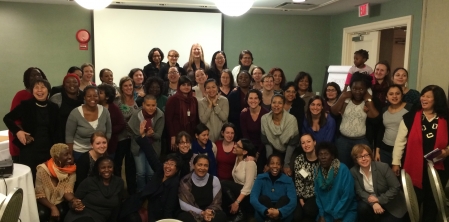
Organised by the Center for Women’s Global Leadership (CWGL), Development Alternatives with Women for a New Era (DAWN), the International Planned Parenthood Federation – Western Hemisphere Region (IPPF/WHR), the Realizing Sexual and Reproductive Justice Alliance (RESURJ), and Women in Europe for a Common Future (WECF), a Feminist Strategy Meeting on Post 2015 took place in Tarrytown, NYC in February 2014.


Just after the 8th session of the Open Working Group on Sustainable Development Goals (SDGs), the meeting brought together over 60 representatives of feminists and women’s rights organisations from around the world. Networks, sexual and reproductive health and rights, human rights, governance, gender, violence, peacekeeping, environment, agriculture, economic and education groups were all represented.


For more information, to view the endorsements and read the full text of the declaration, click here.


If you have not done so already, please write to feministspost2015@gmail.com to endorse.


Africa meeting asks to step up efforts to address human rights issues and reform punitive laws for key populations

5th inter agency

Recommendations coming out of the 5th Inter-Agency Meeting on HIV, TB and malaria, directly address the needs of key populations, particularly the consensus to “Step up efforts to address human rights issues and reform punitive laws that hinder access to services for key populations in order to achieve universal access to health services.” 


With the deadline of the Millennium Development Goals fast approaching, over 60 partners from the African Union, Regional Economic Communities, civil society, UN organizations and development partners met in Brazzaville, Congo, from 5-7 March 2014 to streamline harmonization and coordination of AIDS, tuberculosis and malaria responses.


AIDS Accountability International attended as presenters, reporting to the room on our work done to involve communities in decision making and programming, working towards universal access to services especially for marginalized and vulnerable populations, such as women, young girls and lesbian, gay, bisexual and transgender (LGBT) individuals. AAI shared our advocacy work in the SADC region on strengthening the inclusion of the voices of key populations in the Global Fund Country Coordinating Mechanisms (CCM). AAI highlighted our current work to support countries to create Civil Society Priorities Charters as a way of ensuring that civil society takes a common position in CCM deliberations.


AAI also spoke on the panel “Universal Access to HIV and AIDS, TB and Malaria Services in Africa: challenges and prospects”, advocating for a broader, more inclusive, understanding of the term “universal access”, which also speaks to quality of service provision and protection of human rights.


AIDS Accountability advocated for the recommendations from the meeting to be progressive and forward looking. Two of the recommendations directly address the needs of key populations, particularly the consensus to “Step up efforts to address human rights issues and reform punitive laws that hinder access to services for key populations in order to achieve universal access to health services.” AAI also supports the commitment to women and girls in the meeting outcomes.


Click here to view the official press release from the meeting, along with the full list of recommendations. 


Women want governments to act on reproductive rights

Women

Few things, it seems, still make members of the international community more nervous and squeamish than discussions about sexual and reproductive health, particularly when it involves young people and especially when it concerns adolescent girls.

But if any progress is to be made when it comes to crafting the new post-2015 Sustainable Development Goals (SDGs) now under discussion, diplomats, NGOs and any other actors involved will just have to get over it, according to members of the High-Level Task Force for the International Conference on Population and Development.  

In international forums, “The issues that are often bracketed are the gender issues and, among them, the most bracketed are adolescent sexual health and rights—not among boys, but among girls,” said Dr Nafis Sadik, an obstetrician-gynecologist, veteran diplomat and special adviser on policy to the executive director ofUNAIDS, the UN agency dealing with HIV/AIDS.

Sadik spoke on a panel called “Fulfilling the Promise of Gender Equality: Women, Girls and the Post-2015 Agenda” at a side event of the 58th session of the Commission on the Status of Women (CSW58) this week.

“It always makes me wonder why policy makers don’t want girls and women to make decisions about their own bodies,” said Sadik.  “If we really want to eradicate these preventable deaths, women and girls must be able to make choices for themselves,” she said, referring to maternal mortality – 800 women per day – as a result of lack of healthcare and access to modern contraception.

“These are issues the international community needs to address squarely and not sweep under the carpet” due to cultural squeamishness, she said.

She noted that the right to reproductive health was dropped from the last set of Millennium Development Goals (MDGs).  Had that not happened, she said, “I think we’d have a different world today.”

Today’s world has an historically high number of young people and their sexual and reproductive health and rights concerns also were left out of the last MDGs, said panellist Amina Doherty, a youth advocate and member of the board of the Global Fund for Women.

That must change in the new set of SDGs, she said. “Even though we’re mobilizing, we’re here, we were invited, we see our issues are not on the agenda. We’re tired of lip service.  We’re tired of ‘youth’ being a buzzword.”

That voice is crucial for the future, said Crown Princess Mary of Denmark, a member of the High-Level Task Force for the ICPD, an independent body established in 2012 to advocate for gender equality, the empowerment of women and young people and the sexual and reproductive health and rights of all.

Acknowledging that “sexual and reproductive health and rights remain a highly controversial issue,” she noted that 16 million adolescent girls in developing countries die annually as a result of complications of pregnancy and childbirth, often as the result of early or forced marriage.  One-third of girls report that their first sexual encounter was forced on them.

“For me, it’s clear that gender equality should be a standalone goal,” said the Crown Princess on the panel.

The needs of adolescent girls were also on the mind of Michel Sidibé, executive director of UNAIDS.

He pointed out that 24 percent of young girls globally don’t know how HIV/AIDS is transmitted.  As a result, in South Africa for example, the infection rate among young men between the ages of 19 and 20 is 1 percent, compared with 16 percent for girls in the same age group.

“We will not end this epidemic if we don’t have the courage to focus on who has been left behind – women and girls,” Sidibé said.

The question, the panellists said, is whether governments have the will to make the changes that will promote gender equality and save the lives of women and girls.

“Since we know what works and what we need to do, we must just do it,” said Sadik.  “Ideology and false value systems should not stand in the way of doing the right thing.”

By Lisa Anderson

13 March 2014

Source: http://www.trust.org/item/20140313124546-9qwa1/?source=dpagehead

Africa: Women – Experts Call for Engaging Men and Boys As Allies in Fight for Gender Equality

Key Pop

Gender equality is not just a concern for women and girls, a panel of experts gathered at the United Nations in New York stressed today, highlighting the need to engage men and boys as allies and agents of change in this global struggle.


"Gender equality isn't just a women's issue. It is an issue for all. It is a rights issue because women's rights are human rights," declared Phumzile Mlambo-Ngcuka, Executive Director of the UN Entity for Gender Equality and the Empowerment of Women (UN Women), as she kicked off an event on the margins of the annual session of the Commission on the Status of Women.


"Working with men and boys, transforming masculinity and traditional perceptions of manhood must be part of the gender equality agenda," she added.


Ms. Mlambo-Ngcuka highlighted a new campaign launched by UN Women last week on the occasion of International Women's Day called #HeforShe, in which men all over the world are being encouraged to speak out against the inequalities faced by women and girls.


Speaking directly to men and boys during the launch, she called on them to take a stand, to speak out and take action for their sisters, mothers, daughters and partners. "Because silence and inaction of good men conspire against women," she stated.


Today's event, organized by Switzerland and Brazil, focused particularly on engaging men and boys to achieve the Millennium Development Goals (MDGs) – which call for the reduction of extreme poverty and other global ills by 2015 – for women and girls. MDG 3 is specifically targeted to gender equality and the empowerment of women.


"Persistent gender inequalities and discrimination of women and girls are a major obstacle to sustainable development, including poverty eradication and economic growth," said Benno Bättig, Secretary-General of the Federal Department of Foreign Affairs of Switzerland and moderator of the discussion.


MDG 3 gave women's issues some visibility, he noted, however it is silent on several key gender issues, such as violence against women and women's unequal participation in decision-making. To address not only the symptoms but the very root causes of discrimination against women and girls, Switzerland supported a stand-alone goal on gender equality and women's empowerment in the post-2015 development agenda.


"To overcome structural impediments to full gender equality, gender roles and relations must be transformed," said Mr. Bättig. "And this transformation not only concerns women and girls, it requires the active involvement of men and boys."


He added that while the engagement of men as allies has received little attention so far, it can have significant benefits for women and children, as well as for men themselves in contributing to the full achievement of all the MDGs.


The Swiss Government supports a project called "the part-time man" that promotes flexible working hours and conditions that allow men to spend more time with the family and giving women more time for their careers.


"Furthermore, our experience has shown that in societies where social norms and family honour are prevailing factors, a positive change in women's social status is only possible when men's attitudes change," Mr. Bättig stated. "We thus have to work with men and boys as strategic allies and partners to achieve gender equality."


Bafana Khumalo, of the South Africa-based gender equality organization Sonke Gender Justice, highlighted the engagement of men and boys as a means to try to limit the spread of HIV and promote women's empowerment.


He highlighted Sonke's flagship campaign, known as "One Man Can," which has proven to be an effective way to change the HIV and gender-related behaviours and attitudes of men and women. It also contributes to the decrease in the use of violence by men against women, reduces the number of sexual partners, and increases their use of condoms, testing and services.


Sonke's framework for engaging men and boys emphasizes three critical perspectives, he noted. These are involving men and boys as agents of change; engaging men and boys as equal partners; and treating men and boys as clients, so they can access and utilize services relating to their sexual and reproductive health rights.


Also highlighting the need to view men and boys as agents of change was Oswaldo Montoya from Nicaragua, the Global Coordinator for MenEngage, who also stressed the importance of offering men and boys opportunities to help them "step out of the masculinity box" and providing them with safe spaces to do so.


"I would like to propose to men and boys: forget about masculinity, embrace your humanity," he stated.


Mr. Montoya also encouraged UN Women to appoint a focal point to advance the important work being done with men and boys and to engage more of them in the pursuit of gender equality.


Antonio de Aguiar Patriota, Brazil's Ambassador to the UN, said that gender should be taken to refer to both women and girls, and men and boys. "When we discuss gender, we generally miss the reality of men and boys, their potential contribution to the empowerment of women and girls and their own gender-related specificities and vulnerabilities.


"Fully addressing all dimensions of gender inequality is a task that each and every one of us has to take very seriously – rich and poor, North and South, government and non-governmental organizations, government and private sector, men and women."


A "sobering reminder" of the comparatively unfavourable situation of women in the world, he pointed out, is that out of the 193 Member States of the UN, only 8 have women serving as President and 13 as Head of Government.


"I am convinced that it is truly revolutionary to bring men and boys on board on the discussions on overcoming gender inequality," Mr. Patriota said. "As we acknowledge that mainstream and rigid concepts of masculinity and femininity reinforce unequal and vertical power relations between men and women, we also help to accelerate progress on gender equality…


"It is time for men to join forces and enhance their role in helping to achieve a more egalitarian society. This is a win for women, a win for men and a win for our common humanity."


12 March 2014

Source: http://allafrica.com/stories/201403131528.html?viewall=1

Open Letter to African Leaders: one question for you, why do you choose to hate?

r-CAMEROON-GAY-CONVICTION-large570

Dear African Leaders,


I hope this letter finds you in good health.


I want to just say I am deeply disappointed, hurt and scared of you. I wake up every morning and I question my thoughts and views of african renaissance, I question my birth right, my ability to decide to build a family, I question relations to my family, relatives, friends, I question my ability to contribute to transformation, I question my contribution to economy, to empowerment, I question my freedom, I question my feelings and my life.


After spending so much time questioning myself, I have come to one conclusion-I chose to LOVE, love myself, love my neighbour, love my parents, love my education, love my God, love my community, love my country, love Africa, love the world, love my past, love my people, love my partner,  love my children, yes my children……I said it my children.


Do you know how I feel? Do you think you have the right to speak and decide about what I want?well till you speak to me, I will say you have no idea, all you do is hurt, hurt and hurt, and take away my freedom, let me also remind you, your take on homosexuality, on gender equality, and human rights has and continues to cost lives.

I have asked myself why? Why do you continue to hurt an African child? Why do you continue to hurt sons and daughters of the soil?is this self interest, is this power dynamics, you gamble with my life, my brothers and sisters lives?


Let me say this ………


You need to remind yourself about what demonstarting love is and what it means. True and sincere love does not insist on its rights. In the final analysis, there are two kinds of people in this world: those who lay claim to their rights and those who think about their duties; those who lay claim to their privileges and those who always think about their responsibilities; those who think that life owes them something and those who thinks that they owe life something.


People can be divided to into "grabbers" and "givers". The grabbers are those who, with clenched fists and white knuckles, constantly cling to what they regard as theirs, they are dirt poor, bankrupt in love. Mercifully, we also get givers. Those who are like the myrtle-tree on the plains that gives its lovely fragrance to the heavens, without expecting something in return.


If you were to think less about yourself interest political agenda and power, stop using me as your entry point to gaining and maintaining your power, and think more about your obligations to all in our diversity, you will be serving the world, your people, shaping the future, you will be revealing what love is, you will be revealing a revelation of true love.


All I see in you is self driven agenda of power, you have drifted from the people, from the interest of Africans. Your reluctant to reveal the true leadership qualities. You appear to be cold and introverted, you are afraid of being misunderstood, you rather make others be and feel misunderstood. This is really sad, because so many unexpressed emotions, dialogues and quality leadership views -could have enriched the world-however we remain slumbering in personalities and your personal views.


One of the characteristics of love is expressing appreciation and acknowledging others through love. It takes so little to say it loud, and yet, it brings so much joy to both giver and grabber(receiver). Love can be demostrated in a variety of practical ways. It can rise above mere sentimental emotions and enable you to make a way of life out of it, that can enrich the lives of your loved ones.


It is my experience and experiences of  others, men and women including gays, lesbians and transgender people that is filled with declared love can be fulfilling and practical. Love not hate.

African Leaders why don't you start today?


Demonstrate love for your nations that you are tasked to protect, promote and uphold, demonstrate love for your people, demostrate love for Africa, demostrate love for the world.

I stand!


Yours,

Mmapaseka Steve Letsike


This letter is written in my personal capacity. Inspired by Archbishop Desmond Tutu,  Solly Ozrovech and my mother the late Johanna K Letsike (anti-apartheid activist).


Mmapaseka Steve Letsike is with Anova Health Institute, South African National AIDS Council, National Council against Gender Based Violence and with Chapter ll.

Keep Calm: African CSO Post 2015 Coalition Advocacy Strategy Meeting.

AIDS Accountability International Africa CSO Coalition Post 2015 10AIDS Accountability International Africa CSO Coalition Post 2015 6


The International Conference on Population and Development, Commission on the Status of Women and the Post 2015 Development Agenda review processes are all important opportunities for African civil society to influence the future development agenda.


In the Africa review process of the ICPD, SDGs and CSW (that resulted in several continental positions on the post 2015 development agenda) it became clear that is civil society requires better collective organization and strategizing to perform effective advocacy. This needs to happen both at country and regional level so as to ensure the greater inclusion of Sexual Reproductive Health and Rights (SRHR) in the outcomes of these processes.


Countries will be committing to their new positions in New York (NYC) this year and the sole remaining opportunity available to civil society is to affect the position of each African country prior to their vote.


As a means to affect these country positions AAI will be leading the African CSO Post 2015 Coalition which is intended to ensure that African civil society works strategically for the best outcomes. We will thus be holding a meeting in Johannesburg in March/April (date to be confirmed) that will map out the position of countries in Africa with regard to their position on SRHR, and we will plan as a group how we can affect the outcomes in NYC.


We are looking for a particular set of people at this meeting, so if think you fit the criteria, or know someone who does, nominate them to nomvuyo@aidsaccountability.org Read more about the meeting, and the criteria click here.