Category Archives: ICPD

Are you in(volved)? Are you in(vited)? Are you in (ICPD)?

Are you in (ICPD)?
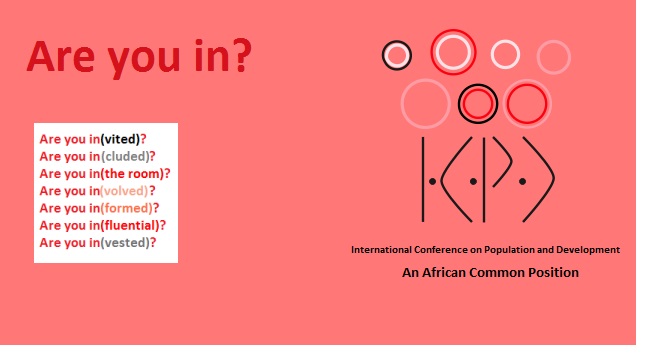
On 30th September – 4th October 2013, the African Regional Conference on Population and Development will be held in Addis Ababa to review progress toward the ICPD Programme of Action. This conference will bring together representatives from African government, civil society and youth organisations, and will agree a set of priorities, challenges and emerging issues for the African region.

Are you in(vited)?

From the 24th-25th September, youths from across Africa will come together during the Youth Pre-conference to identify their priorities. This will be followed by the CSO Pre-conference to be held on 26th-27th September (also tasked with identification of priorities). These combined recommendations will be presented before the experts prior to the Ministerial meeting from 30th– 4th September, 2013.

Are you in(formed)?

In response to the ICPD Programme of Action (PoA), the African Union Commission (AUC), AAI and the African Population Commission (APC) worked together to develop the African Common Position on ICPD by means of Regional Consultative Meetings which was followed by a second round of E-consultations. This generated recommendations from over 70 African experts in line with key themes within the document. On completion and adoption of all these recommendations, 342 civil society organizations signed the CSO African Common Position endorsing it as a document that represents their needs going into the Sept conference and ICPD Review process.

The CSO ACP was submitted to H.E. Dr. Mustapha S. Kaloko, the Commissioner of Social Affairs at the AUC on 5 June, 2013. The CSO African Common Position on ICPD is expected to inform the youth, CSO pre-conference documents and the experts meeting. We are currently lobbying those who will be in the experts’ room, and ensuring ministers of health receive a copy of the CSO African Common Position on ICPD prior to the conference. In addition, we continue circulating the CSO African Common Position through all our social media platforms.

Are you in(volved)?

Read more on the African Common Position on ICPD, as this document contains a set of recommendations aimed at the African Union Commission and Africa’s national governments so as to address population and development issues on the African Continent in the ICPD+20 review process. This will ensure your meaningful participation at the Regional Conference on Population and Development as we advocate for key priorities for Africa. We further ask you to be involved by lobbying your contacts too for inclusion of contents of the CSO African Common Position and vote at the Regional Conference on Population and Development. Lastly, follow us on Twitter, Facebook and LinkedIn for continued updates.

To make it easier for you, AAI has distilled the full Civil Society African Common Position on ICPD into a 2 page Key Messages in Brief document

The African Common Position is also available in Portuguese, French and Arabic:

Agora disponivel em portugues

Maintenant disponible en francais

الآن باللغة العربية

We sincerely hope that you will find the above information useful as we prepare for the Regional Conference on Population and Development.

Best regards,

The AAI Team


Are you in(vited)?

UNECA – United Nations Economic Commission for Africa : Regional Conference on Population and Development Beyond 2014 – Harnessing the Demographic Dividend: The future we want for Africa

Joint Media Advisory

New Dates: Regional Conference on Population and Development Beyond 2014

Harnessing the Demographic Dividend: The future we want for Africa

New Dates:  The ICPD Regional Conference on Population and Development Beyond 2014 will take place from 30 September – 4 October 2013  in Addis Ababa, Ethiopia. As part of a UN mandated review of the 1994 ICPD Programme of Action, the conference will be attended by representatives of governments from across the continent. The intergovernmental meeting will be preceded by civil society, youth and expert pre-events, scheduled from 24-27 September 2013.  The pre-events will contribute to the conference which aims to achieve an African Common position in relation to taking forward the agenda of the ICPD in the 21 st  Century. The outcome from the conference will contribute the ICPD Beyond 2014 Global Report and is intended to influence the global development agenda.

Venue : All the ICPD Beyond 2014 Conference events will take place at the UN Conference Centre, Addis Ababa, Ethiopia

Pre-Events:

African Youth Forum: 24 -25  September

Civil Society and Experts meeting: 26 -27  September

Regional Conference on Population and Development Beyond 2014: 30 September – 4 October

Registration:  Invited media from outside of Ethiopia will be requested to register upon confirmation of their participation.

Notes for Editors:

The purpose of the conference is to review evidence of progress, challenges, gaps and emerging issues in relation to the achievement of the goals set out in ICPD agenda with the aim of making recommendations that will accelerate progress towards the goals set out in the 1994 Programme of Action.

Key inputs to this process are the report on regional findings from the ICPD Global Survey, which was facilitated by the Economic Commission for Africa (ECA) and completed by 52 countries in the region and the African Common Position on ICPD.

The conference will also consider the draft report of the operational review of the ICPD Plan of Action in Africa, recommendations of the operational review, and the African common position on ICPD beyond 2014.

This conference will bring together ministers responsible for population and development matters, government experts, research and training institutions, the Pan-African Parliament, Regional Economic Communities, United Nations agencies, international organizations, civil society organizations, and the youth.

By exploring the implementation modalities and considering challenges and opportunities, the meeting is expected to come up with more effective approaches and tools for population programmes and policies.

The resolution of the United Nations General Assembly on the follow-up to the International Conference on Population and Development (ICPD) Beyond 2014 mandates an operational review of the implementation of the Programme of Action (PoA) on the basis of the highest-quality data and analysis of the state of population and development, taking into account the need for a systematic, comprehensive and integrated approach to population and development issues.

Consequently an operational review has been undertaken by the UN Economic Commission for Africa (ECA) on the African continent in collaboration with the United Nations Population Fund (UNFPA). In order to generate a holistic and in-depth assessment, questionnaires were administered and 52 African member States provided feedback. The process also included a review of country reports and country implementation profiles; relevant policy decisions; strategies and programmes that have been formulated to implement actions in line with the various themes of the PoA; the institutional frameworks and governance structures that have been put in place; and the resources that have been mobilized to implement the policies, programmes and strategies. The process thereby documented the achievements made, challenges and constraints faced, as well as the gaps identified. The review has also provided the opportunity to identify strategic priorities for population and development on the African continent. It is intended, therefore, that the outcome of the process will guide the ongoing dialogue to define the ICPD agenda post 2014, and to contribute to the development agenda post 2015 on the continent.

The final regional report of the operational review for Africa, as well as an African common position on ICPD beyond 2014 will be included in the Global Report. It is intended that the regional conference being organized for 30 September to 4 October 2013 will validate the report.

Jointly Issued by: UNFPA, ECA and the African Union


http://www.4-traders.com/news/UNECA-United-Nations-Economic-Commission-for-Afr–Regional-Conference-on-Population-and-Developme–17274054/


Are you in(volved)?

African Women MPs Discuss Family Planning

Kampala — African women MPs and leaders want parents to allow their teenage daughters to access family planning and reproductive health services with a view of bringing down the increasing cases of early and unwanted pregnancies, risky abortions and maternal deaths.

The women leaders on a two-day capacity building meeting that opened on Sunday at Speke Resort Munyonyo discussed ways on how they can reposition family planning and reproductive health on the development agenda of their respective government budgets.

The meeting was organized by Partners in Population and Development Africa Regional Office (PPDARO) in collaboration with the Health Policy Project and drew participants from Ethiopia, Malawi, Ghana and Uganda the host.

Former Kalangala district Woman MP, Ruth Nvumetta Kavuma, who is a member of the African Women Leaders’ Network said that one of the major objectives of the meeting is to ensure leaders push issues of family planning and reproductive health in their countries to get increased funding.

Increased funding, she pointed out, would be key in lowering the infant and maternal mortality rates and make family planning services accessible to all women.

Amid such efforts, most parents, especially mothers still carry a negative attitude of family planning and reproductive health to their teenage daughters, said Kavuma.

And the mindset is that some mothers think that by letting their teenage daughters to access family planning services, it would lead them into promiscuity.

“But parents ought to explain all issues around family planning and reproductive health to their teenage girls so that they are aware of the outcomes of any activity they might desire to involve themselves in, including early sex,” she said.

The former lawmaker underscored the need for parents to let their teenage daughters access family planning contraceptives because of the potential of early exposure to sexual activity.

“We want parents to allow the teenage girls to attend family planning meetings at various health facilities so that they can access information and services that can help them to avoid early sex and pregnancies and how to deal with all issues around reproductive health.”

Dr. Jotham Musinguzi, the PPDARO director said there is need for African governments to increase funding towards family planning services.

He said, in Uganda for example, at least 34% of couples desire to have family planning services to space their births but cannot access them.

He went on to stress that efforts should be made to ensure this portion can have voluntary family planning services.

“If women can access voluntary family planning services, they will avoid risky and unwanted pregnancies and deaths, leading to spaced births that will be reflected in other sectors like gainful employment,” he said.

He explained that although Uganda has seen increased funding towards family planning in the last four years, there is still need to improve on policies that can benefit the grassroots women to access better health services.

Ellen Thokon Solomon from the Malawian parliament said many teenage girls in her country who became mothers disclosed that they had never received any information regarding family planning and therefore lacked knowledge on how to avoid early pregnancies.

Other young mothers in Malawi say, according to Solomon, that they would want to use family planning methods but cannot access the services or are not aware of facilities where they are available.

She therefore appealed for increased funding so that these services could be available to all women at the various lower health faculties.

By Eddie Ssejjoba

17 September 2013

http://allafrica.com/stories/201309171114.html?viewall=1


Are you in(cluded)?

Failure to include reproductive health for women as a priority affects sub-Saharan African economies, expert says

Failure for Sub-Saharan African countries to work towards achieving Millennium Development Goals on health will impact all other aspects of development including economic growth, Akatsa Bukachi, Director, Eastern Africa Sub-region Support Initiative for the Advancement of women (EASSI) has said.

Speaking to Africa Science News in Busia town, Bukachi said the Sub-Saharan Africa region is deficient in areas of reproductive health that is crucial for addressing the MDG on Children and maternal in health. Bukachi observed that reproductive health is fundamental in the advancement of women and girl child in Africa.

She noted that the African continent will only achieve its MDG on health if proper incentives to improve family planning, reduce maternal mortality and prevent HIV/Aids infections are prioritized. Family planning as a strong component of better reproductive health has steadily declined in the recent years in sub-Saharan Africa but it needs to be prioritised.

In the last 10 years, Sub-Saharan Africa region still grapples with the highest number of maternal mortality ratio of 500 maternal deaths in 100,000 lives.

Bukachi said that despite most countries in the region boasting that the number of women dying as a result of pregnancy and child birth-related complications has declined to 47 percent from more than 543,000 to 287,000 cases globally has been registered, nonetheless, the war against maternal mortality especially is far from over. She called for synergy to advocate for a strong pillar in reproductive health agenda.

The Director disclosed that reproductive health challenges are huge and women should take their positions in addressing the problems.

The Eastern Africa Sub-region Support Initiative for the Advancement of women is on the front to advocate for a complete diet and women girl child health situation in Eastern Africa Region.

In most cases in Africa continent, nutrition has always played out in the rising statistics of maternal mortality ratio in Sub-Saharan Africa.

The organisation operates in eight Eastern Africa Countries namely Kenya, Uganda, Tanzania and Somalia. Other countries in clued; Ethiopia, Rwanda, Eritrea and Burundi.

By Cheki Abuje

http://www.africasciencenews.org/en/index.php?option=com_content&view=article&id=940:poor-reproductive-health-to-affect-sub-saharan-african-economies-expert-says&catid=63:health&Itemid=114

CALL FOR SELF FUNDED ORGANISATIONS: ICPD Africa Youth Pre-Conference


As part of the on-going review of the ICPD Programme of Action for 2014 and beyond, the Regional Population Conference is being planned by the United Nations Economic Commission for Africa together with other partners in September 2013 in Addis Ababa – Ethiopia.

Following the success of the Global Youth Forum and the resounding outcome of that process, it is important that young people from across Africa have an opportunity to discuss in greater details the issues and recommendations that are most relevant to them in relation to the ICPD and Post 2015 development agenda.

As part of the review process, there will be a Youth Pre-Conference to the African Population Conference which is an official part of the main conference and its outcome will be presented to both the Experts Meeting and the Ministerial Meeting.  A number of young people have been selected through national consultations with relevant stakeholders to participate in the Youth Pre-Conference to the African Population Conference.  In addition to this, the Africa ICPD Youth Steering Committee is sending this call out for self-funded youth-led and youth focused organizations to express their interest. There will be about 30 spots allocated to self-funded participants.

We expect participants in the Youth Pre-Conference to be:

  • A leader, or emerging leader, currently working at national, regional or global level in an area that contributes to the ICPD Programme of Action;
  • Working in a paid or voluntary capacity for a civil society organisation engaged in policy development at national and local levels;
  • Working in a paid or voluntary capacity for organizations that have a demonstrable national and/or international reach and mandate;
  • Able to demonstrate outstanding youth advocacy and networking capabilities with concrete examples of achievements in these areas in different contexts;
  • Below the age of 35 with special emphasis on youth under 25 years and youth from vulnerable groups


When considering candidates for the youth pre-conference, the Youth Steering Committee will take into account the following key knowledge, skills, awareness and values:

  • A commitment to the values of ICPD
  • Leadership experience
  • Innovation in the arena of policy development and application
  • Desire to contribute to and improve the leadership potential for the civil society sector
  • Willingness to learn and share
  • Eagerness to lead debate and discussions during the youth pre-conference
  • Commitment to follow up activities
  • Track record of achievement/work in ICPD and the Post 2015 development Agenda
  • Proof of availability of funding for youth pre-conference participation


We therefore invite interested organizations and individuals (young people) to submit Letters of Interests to participate in the Youth preconference to the Africa Population Conference.

Selected self-funded participants will have to cater for their flights, accommodation and living costs. Snacks, lunch and conference materials will be provided by the organizers. Please send your expression of interest to be considered for one of the 30 spots for self funded participants to the Youth Steering Committee by sending us your:

  1. Name of Sponsoring Organisation
  2. Name of Participating Organisation(if different from 1 above)
  3. Name of Representative and short biography.

Please send this information to icpdysc@gmail.com no later than 2nd August, 2013.


In Sierra Leone, “HIV/AIDS, TB & Malaria Pose Serious Threats to Development in Africa”…President Koroma tells Counterparts


President Dr. Ernest Bai Koroma has said that HIV/AIDS, Tuberculosis and Malaria pose serious threats to the socio-economic development of Africa.He made this statement on the occasion of the Special Summit of the African Union on HIV/AIDS, Tuberculosis & Malaria in the Nigerian capital, Abuja on Monday 15th July, 2013.

The theme of the two-day summit is ‘Ownership, Accountability and Sustainability of HIV/AIDS, Tuberculosis and Malaria Response in Africa: Past, Present and the Future’.


President Koroma informed his colleague Heads of State and Government that Sierra Leone has drastically reduced HIV infections and was now aiming towards a zero tolerance plan against the malaise. Whilst acknowledging the challenges facing the fight, he however maintained, “We have shown leadership as a nation”.


The president also informed the Summit that in the fight against malaria & TB, the Government of Sierra Leone has made tremendous progress and was still making the necessary efforts to minimize the presence of these syndromes in the country.

President Koroma further used the platform to continue to appeal to donors to increase funding to enable performing governments accomplish their struggle against HIV/AIDS, Malaria and Tuberculosis in Africa.He also called on all to renew their vow and fight against these diseases so that the continent will realize sustainable socio-economic development.

He commended his Nigerian counterpart His Excellency Goodluck Jonathan and the African Union for the initiative to organize a Special Summit to implement the Abuja Call for Accelerated Action towards Universal Access to HIV/AIDS, Tuberculosis and Malaria treatment services in Africa.


In his opening remarks, the Nigerian President Goodluck Ebele Jonathan said the presence of his colleagues at the Summit signifies the importance they attach to the development of Africa. He pointed out that these diseases were crucial to the socio-economic development of the continent and still remain major causes of morbidity and mortality. President Jonathan therefore urged his colleagues to give the relevant attention needed to address these syndromes.


Commending Global Fund for being the major funding agency that continues to sustain the fight against malaria, TB and AIDS, which he dubbed a “noble mission”, President Goodluck Jonathan called on his colleagues Heads of States and Government to take ownership of the process. He also implored them to sustain their commitment, noting that the Summit was also to review their total achievements so far and make a renewed commitment towards the challenge.


The President also acknowledged other development partners for their immense support and efforts towards the fight against malaria, TB and HIV/AIDS in Africa.

According to the World Health Organization (WHO), of the World’s thirty four million people living with HIV, 23.5 million are in Sub-Saharan Africa, and 21 of the Global Plan’s 22 focus countries are in Africa. Similarly, the World Health Organization (WHO) estimates that there were about 219 million cases in 2010 and about 90% of the estimated 660,000 deaths from malaria in that year occurred in Africa. Africa also carries a large burden of the TB disease with 30% percent of the approximately 9 million new TB cases each year and 9 of the 22 most affected countries coming from Africa.


Recognizing the devastating impact of HIV/AIDS, TB and Malaria and other related infectious diseases on the socio-economic development of Africa, the Heads of State and Government of Africa adopted the 2000 and 2001 Abuja Declarations and Action Frameworks committing Africa Union Member States to take measures to halt the progression of these diseases in Africa. This high level commitment, reinforced on multiple occasions at the continental level over the past five years, marked a turning point in the continental response to the three diseases stimulating a sharp increase in resources and the scaling-up of programs to fight HIV/AIDS, TB and Malaria.


Although countries have strengthened their interventions in many of the priority targets set by the Abuja Call, they still continue to face constraints due to the lack of financial, material, technical and human resources for addressing health needs. Increase access to Anti-Retroviral Treatment (ART) is imperative. It is against this background that the Heads of State and Government during their Twentieth Ordinary Session of the January 2013 Summit held in Addis Ababa, endorsed the offer made by the Federal Republic of Nigeria, to host the Special Follow-up Summit on the Abuja 2001 Africa Union Summit on HIV/AIDS, Tuberculosis, Malaria and other related communicable diseases in the third quarter of 2013 to address the numerous challenges that will enable Africa realize the Abuja Call objectives and the Millennium Development Goal (MDG) on health.

On arrival in Abuja, Nigeria, President Koroma was received by the Special Adviser to President Goodluck Jonathan on Performance Monitoring and Evaluation, Professor Sylvester Monye, where he was taken to CGOCC Company Limited for a brief presentation on projects undertaken by the company on hydro electricity and water supply.


By State House  Communications

17 July 2013

http://news.sl/drwebsite/publish/article_200523238.shtml

UNAIDS lauds U.N. Women executive director Mlambo-Ngcuka appointment

The Joint U.N. Programme on HIV/AIDS welcomed the appointment on Thursday of Phumzile Mlambo-Ngcuka as executive director of the U.N. Entity for Gender Equality and the Empowerment of Women.

Mlambo-Ngcuka was the first woman to hold the position of deputy president of South Africa, where she played a significant role in the country’s HIV program. Mlambo-Ngcuka was a chair of the South African National AIDS Council and took a lead in developing broader and more cohesive collaboration with civil society and international partners.

“Ms Mlambo-Ngcuka is a respected leader and brings with her a wealth of experience in promoting the human rights of women and girls,” Michel Sidibé, the executive director of UNAIDS, said. “She will be an important partner in the AIDS response as women continue to be disproportionately affected by HIV. We look forward to working closely with her to improve the lives of women and girls everywhere.”

UNAIDS said that respect for women’s reproductive and sexual health and gender equality are a necessity for effectively responding to HIV. Gender inequalities make girls and women more vulnerable to HIV and keep them from accessing HIV services.

U.N. Women was created in 2011 to provide a voice at national, regional and global levels for women’s equality and rights. The entity highlights the contributions and priorities of women living with or affected by HIV, contributing to the integration of gender aspects into policies developed by AIDS councils in more than 35 countries and regional programs.

Starting in June 2012, U.N. Women became the newest of UNAIDS’ 11 co-sponsoring organizations.

By Bryan Cohen

15 July 2013

http://vaccinenewsdaily.com/medical_countermeasures/326063-unaids-lauds-u-n-women-executive-director-mlambo-ngcuka-appointment/

Women’s Rights in Africa: 18 countries are yet to ratify the Maputo Protocol!

On the eve of the 10th anniversary of the Protocol to the African Charter on Human and Peoples’ Rights on the Rights of Women in Africa (Maputo Protocol), the Coalition of the campaign, Africa for Womens’ Rights : Ratify and Respect reiterates its call for the continental ratification of this progressive instrument within the African human rights system and for its effective implementation.

Adopted on July 11, 2013, to complement and strengthen the articles of the African Charter related to the protection and promotion of women’s rights, the Maputo Protocol is an important instrument of reference. Its provisions, with regard to civil and political rights, physical and psychological integrity, sexual and reproductive health, non-discrimination, economic emancipation, among others, symbolise African States’ commitments to put an end to discrimination, violence and gender stereotypes against women.

« The adoption of the Maputo Protocol was an exceptional moment, historical for the realisation of the rights of women in Africa. Today, this instrument constitutes a model, a endless source of inspiration. Provided its ratification and full implementation, it can represent a real tool of action for the lasting transformation of our societies » declared Soyata Maiga, Special Rapporteur of the African Commission on Human and Peoples’ Rights (ACHPR) on the rights of women in Africa.

36 out of 54 member States of the African Union (AU) have so far ratified the Protocol, a clear victory for those who over the years have tirelessly mobilised and worked to achieve this goal. Moreover, in many countries, legal and institutional measures, such as laws prosecuting perpetrators of sexual violence (Kenya, Liberia), criminalising domestic violence (Ghana, Mozambique), prohibiting female genital mutilation (Uganda, Zimbabwe) or establishing mechanisms mandated to promote women’s rights (Côte d’Ivoire, Senegal), have accompanied these ratifications.


See the interview of Soyata Maiga, Special Rapporteur of the African Commission on Human and Peoples’ Rights (ACHPR) on the rights of women in Africa, on the progress made and challenges remaining since the adoption of the Protocol (interview conducted on 10 July 2013)


Despite these notable achievements, there are still some obstacles to the full realisation of women’s rights on the continent. Eighteen (18) states [1], have still not ratified the Protocol, and in several of these countries – including Sudan, Central African Republic or Egypt, which still facing serious political crisis or situations of armed conflicts – women continue to be the main targets of violence, discrimination and stigmatisation.

For Sheila Nabachwa, FIDH Vice President and Ag. Deputy Executive Director (Programs) at the Foundation for Human Rights Initiative (FHRI – Uganda), «Non-State Parties should understand that, today, the trend goes on the other side. 10 years after its adoption, it is time for these States to ratify the Protocol and accept that the guarantee and protection of women’s fundamental rights can no longer suffer from political, cultural or religious considerations or pretexts ».

In State Parties, several of the rights enshrined in the Protocol, or provided within national laws, are yet to be fully implemented. In DRC, Guinea-Conakry, Mali, thousands of women victims of sexual violence continue to demand justice and compensation; in Uganda, they are still waiting for equality within the family to be recognised ; in Nigeria, they continue to fight for their right to property to become a reality. Unfortunately, most of the State Parties do not respect their obligation, under article 26 of the Protocol, to indicate, in their periodic reports submitted to the ACHPR, the measures undertaken for the full realisation of women’s rights as provided within the Maputo Protocol.

«The adoption of the Maputo Protocol by African States represented a formidable progress from a legal point of view ; its effective implementation should now symbolise the respect of the obligations they have freely consented to abide by » declared Mabassa Fall, FIDH Representative to the African Union.

On this tenth anniversary of the Maputo Protocol, the Coalition of the Campaign Africa for Women’s Rights: Ratify and Respect pays tribute to the determination and courage of the women and men who advocate tirelessly to ensure that the rights guaranteed in the Maputo Protocol are not lost. In this regard, our Coalition notes with concerns the repeated attacks in several countries against women activists, a phenomenon that must be taken seriously and to which States must respond without delay. The Coalition of the Campaign calls on all national, regional and international actors to join the considerable efforts that are made on a daily basis for the ratification and enforcement of the Maputo Protocol.
SOURCE : International Federation of Human Rights (FIDH)10 July 2013

http://world.einnews.com/pr_news/158178028/women-s-rights-in-africa-18-countries-are-yet-to-ratify-the-maputo-protocol

World Population Day 2013 Raises Teen Pregnancy Awareness.

Indian mother Sonia (R) looks on as her newborn baby girl sleeps at a government hospital in Amritsar on July 11, 2013, on the occasion of World Population Day. Africa and Asia are the continents that will see the fastest urban population growth in the next 40 years, a UN report said earlier in the year noting that India and China are leading the surge. The Earth's population is expected to roughly triple by 2050 compared to a century earlier. It stood at three billion in 1950, reached seven billion.

The United Nations designates every July 11 to highlight issues related to population growth, including environmental sustainability, global development, health care and youth empowerment.

With 16 million girls under 18 giving birth and 3.2 million of these teens experiencing unsafe abortions each year, the U.N. has focused the theme of 2013’s World Population Day on teenage pregnancy, highlighting the important role that teen girls play in positively impacting future generations and underscoring the importance of providing them with adequate health care and educational resources.

U.N. Secretary-General Ban Ki-moon released a statement today raising awareness about the dangers and complications of unplanned teenage pregnancies.

“Complications from pregnancy and childbirth can cause grave disabilities, such as obstetric fistula, and are the leading cause of death for these vulnerable young women,” he wrote. “Adolescent girls also face high levels of illness, injury and death due to unsafe abortion.”

The Secretary-General also proposed various solutions to address core issues of the teen pregnancy epidemic.

“To address these problems, we must get girls into primary school and enable them to receive a good education through their adolescence. When a young girl is educated, she is more likely to marry later, delay childbearing until she is ready, have healthier children, and earn a higher income,” he stated.

Several nonprofits worldwide have taken to Twitter to highlight the issue of population growth and this year’s theme of teen pregnancy.

By Nader Salass

11 July 2013

http://www.huffingtonpost.com/2013/07/11/world-population-day-2013_n_3580276.html

Unicef lauds progress on MDGs by Sub-Saharan countries.

Sub Saharan countries are building on impressive strides on health and education, accelerated action needed towards anti-poverty targets

Nairobi, Kenya: – Building on impressive strides made, sub-Saharan Africa must continue to ramp up efforts towards achieving many of the Millennium Development Goals (MDGs) by their 2015 target date, a new UN report says. The Millennium Development Goals Report 2013 launched today by UNSecretary-General Ban Ki-moon in Geneva, finds that sub-Saharan Africa has made steady progress for its 1 billion people, with fewer mothers and children dying, growing numbers of women in power and broadened access to health and education services, alongside sharp drops in malaria and tuberculosis deaths.

The eight Millennium Development Goals, with a number of sub-targets covering a range of poverty, hunger, health, gender equality, education and environmental indicators, were agreed by all countries as an outgrowth of the UN Millennium Summit in 2000, most with a due date of 2015.

The MDG Report 2013 emphasizes that progress for all children in sub-Saharan Africa is “within our grasp.” The region doubled its average rate of reduction of child deaths from 1.5 per cent a year in 1990-2000 to 3.1 per cent a year in 2000-2011, although it still has the highest child mortality rate in the world. From 1990 to 2011 for children under age five, the mortality rate dropped by 39 per cent (from 178 deaths per 1,000 live births to 109) and the proportion of those who are underweight dropped from 29 to 21 per cent. Some countries with high under-five death rates, including Ethiopia, Liberia, Madagascar, Malawi, Niger and Rwanda, reported reductions of at least 60 per cent.

The report says steady progress has been made in expanding access to primary education in the region, with primary school enrolment rates increasing from 60 per cent to 77 per cent between 2000 and 2011.
Efforts to combat diseases are paying off in lives saved, as the region is on its way to halting the spread and reversing the incidence of tuberculosis and is making substantial progress battling malaria. One-third of children were sleeping under insecticide-treated nets in 2011, up from less than 5 per cent in 2000. Among developing regions, sub-Saharan Africa has the second highest access to HIV treatment – 56 per cent of people living with HIV received antiretroviral therapy in 2011.

However, sub-Saharan Africa remains the most severely affected area by HIV. Indicators for women are also improving. Despite having the highest maternal mortality ratio among all regions, sub-Saharan
Africa saw mortality ratios fall by 41 per cent over the past two decades, from 850 maternal deaths per 100,000 live births in 1990 to 500 in 2010.The report says the proportion of parliamentary seats held by women increased from 13 per cent in 2000 to 21 per cent in 2013, the second highest among all developing regions. Globally, one of the highest electoral gains for women in 2012 was seen in Senegal, where women took 43 per cent of parliamentary seats.

The proportion of the region’s population using an improved water source increased from 49 per cent to 63 per cent between 1990 and 2011, according to the report. New sanitation policies adopted in recent years throughout the developing world have shown remarkable success in ending open defecation, a practice that poses serious health and environmental risks to individuals and entire communities. In almost 100 countries, many in sub-Saharan Africa, new approaches to sanitation have taken root and the number of declared ‘open-defecation-free villages’ is rising .The proportion of the world’s population resorting to open defecation declined from 24 per cent in 1990 to 15 per cent in 2011.

Building MDG momentum
Work to boost MDG achievement must continue to tackle some of the greatest challenges for the region, the report says. That includes bolstering development efforts to further reduce the poverty rate, which fell only 8 percentage points over the last two decades, and addressing the needs of 414 million people still living on less than $1.25 a day. Accelerated efforts are also needed to continue gains in combating HIV and to build on the momentum in fighting malaria through the use of insecticide-treated nets. The region had the world’s highest child mortality rate and the second highest prevalence of underweight children among all regions in 2011. That year, one in nine children died before age five, more than 16 times the average for developed regions, accounting for 3.4 million of the 6.9 million under-five deaths worldwide. The pace of change must accelerate even further if the MDG target is to be met, the report says, and efforts must concentrate on countries with the highest number of under-five deaths, such as Nigeria, and countries with the highest under-five death rates, such as Sierra Leone and Somalia, with rates of 180 or more per 1,000 live births.

With the region continuing to face rising demands for education from a growing population, the report says 32 million more children were of primary school age in 2011 than in 2000. Sub-Saharan Africa is also home to more than half the world’s outof- school children of primary school age (32 million out of 57 million) and it has the highest rate worldwide of children leaving school early. Slightly more than two out of five students who started primary school in 2010 will not make it to the last grade. The report also calls for action to improve access to sanitation and the lives of slum dwellers. Between 1990 and 2011, the proportion of the population using an improved sanitation facility increased marginally from 26 per cent to 30 per cent, and the high proportion of slum dwellers dropped slightly—from 65 per cent in 2000 to 62 per cent in 2012.
At a time when renewed sets of commitments to the MDGs are being made, the report says aid is unfortunately lagging. The report states that bilateral net official development assistance to sub-Saharan Africa amounted to $26.2 billion in 2012, an 8 per cent drop from 2011. The current shift in aid away from the poorest countries and Africa, and towards middle-income countries, will continue, the recent survey suggests, with a greater share of aid being offered in the form of soft loans rather than grants.

The Millennium Development Goals Report, an annual assessment of global and regional progress towards the Goals, reflects the most comprehensive, up-to-date data compiled by over 27 UN and international agencies and is produced by the UN Department of Economic and Social Affairs. A complete set of the data used to prepare the report is available at mdgs.un.org


By Standard Digital

1 July 2013

http://www.standardmedia.co.ke/?articleID=2000087250&story_title=sub-saharan-countries-make-progress-on-mdgs