


Men who have sex with men, bisexual and gay men
Scorecard grading on reported HIV Knowledge coverage
The following section seeks to analyses country performance in terms of HIV knowledge for men who have sex with men, including gay and bisexual men, in both 2008 and 2010.

Table 4: Grades of the 39 countries that reported percentage data on Indicator 14 for MSM in 2008.
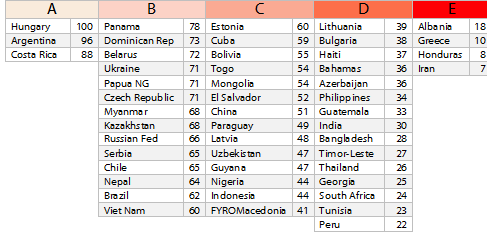
Table 5: Grades of the 50 countries that reported percentage data on Indicator 14 for MSM in 2010.
Significantly we can note that whereas 39 countries reported on Indicator 14 for MSM in 2008, an increase of 11 countries led to a total of 50 in 2010. Over the period we have a total of 59 countries reporting in both years.
Concerns such as 100% coverage in Hungary, (see previous elements and Framework Report for more detail) will not be covered in this section.
There is a general trend towards greater coverage of knowledge for MSM in the group of reporting countries, as more countries fall into the B Grade category in 2010 than in 2008. The number of countries in B grade is double the number from 2008, going from 7 to 14).
Although we see again reporting of the same figure for both years we reiterate, as above, that if a country deems it prudent to only expend budget on research every four years but is adequately addressing the needs of MSM, it is not necessary to criticize them. It is necessary however to note that this is not often the case and reporting every second round, and limiting budget to marginalized groups is often a politically weak option but all scenarios need to be carefully considered and thoroughly examined at national level.
Limitations of the data
This section seeks to address the limitations of the data that the questions posed to respondents places.
In order to arrive at the following: the percentage of most-at-risk populations who both correctly identify ways of preventing the sexual transmission of HIV and who reject major misconceptions about HIV transmission, the UNGASS recommendation is that the following questions be asked:
1. Can having sex with only one faithful, uninfected partner reduce the risk of HIV transmission?
2. Can using condoms reduce the risk of HIV transmission?
3. Can a healthy-looking person have HIV?
4. Can a person get HIV from mosquito bites?
5. Can a person get HIV by sharing a meal with someone who is infected?
UNAIDS also suggests that questions 4 and 5 be replaced, if necessary, with the most popular misconceptions around HIV transmission.
In future developments of the indicator LGBT relevant questions should be included.
Can the use of lubricants reduce the risk of transmission?
Can using dental dams reduce the risk of transmission?
Does early withdrawal reduce the risk for HIV transmission?
These questions also remain relevant for heterosexual people as anal sex is not limited to men who have sex with men, and at the same time does not mean that it is the only form of sex that MSM engage in.