


Male sex workers
The following section seeks to analyses country performance in terms of HIV knowledge for male sex workers (MSW) in both 2008 and 2010.
Scorecard grading on reported HIV Knowledge coverage
It is important to note that only 18 of the 192 countries reported data on HIV knowledge of MSWs in 2008 (15 countries in total) and 2010 (14 countries in total). 11 of these reported in both 2008 and 2010. 4 of these (Panama, The Former Yugoslav Republic of Macedonia, Indonesia, and Bangladesh) reported the same data from 2006-2007 Bio-behavioral surveys in both years.
Before analyzing the actual coverage of HIV knowledge, it is important to recognize the contribution made by the countries that have acknowledged the need to report on Indicator 14 for MSWs. The very fact that leadership is concerned with a vulnerable group of their population and is willing and able to direct resources to empirical evidence is notable and should be applauded.
These 18 countries and their leaders should be recognized for the role they are playing on both a national and global stage in setting a good example by reporting, even if their performance is low. Perhaps especially if their performance is low. It is a well known fact that governments do not like to report statistics that indicate their shortcomings, however, the fact that these countries have begun a process that will hopefully lead them to improvements is commendable and their transparency laudable.
The lack of collecting and reporting data on MSWs by the remaining 174 countries is in itself a significant example of the lack of focus on same-sex groups as well as sex workers and their experiences of the HIV response. AAI firmly believes that UNAID’s aphorism “know your epidemic, know your response” is a necessary part of government obligation from both a human rights and epidemiological perspective. Governments that do not prioritize this data can be said to be failing their citizens and people within their borders.
This said, in some countries this data may have been collected and analyzed by civil society and their contribution may not reflect government ambitions alone but rather that of the effectiveness of national and/or international civil society instead. Family Health International has significantly contributed to many BSS for MSW and their methodology is reportedly used by 6 of the countries reporting in 2010. FHI works closely with governments so indeed this reporting may reflect not replacing governments responsibility but a supportive capacity provided by civil society.
Moreover, from a methodological point of view, the use of the same methodology, of similar sampling methodologies (often respondent driven sampling (RDS)) is useful in creating synergies between datasets and thus adding to the possibilities of comparing data.
Bearing in mind that some countries reported substitute data (data that does not exactly fit the conditions and constraints set by UNAIDS) it is necessary to acknowledge that these countries are still making an effort. This suggests that although their data did not meet the specific criteria set by UNAIDS for the indicator leadership still considers the reporting of the data important. Often countries with limited health care budgets fail to collect data on numerically smaller groups even though they are often the most vulnerable. This is justified by the rationale that there is a greater demand for funding in other areas of work for other groups. This is acceptable practice in some cases and needs to be considered and weighed on a country by country basis. However, oftentimes this substitute data is above the standard of UNAIDS demands and is not comparable with UNAIDS systems. Perhaps the data is available at municipal level for example, and so may reflect a country that has made significant strides in understanding their local challenges.
Similarly the 4 countries that reported the same data from 2006-2007 Bio-behavioral Surveys conducted in 2006-2007 should not be admonished. That the country has already conducted a BSS for MSW is significant, and although ideally all countries should conduct research every two years to monitor progress these countries still represent better response than most.
In the tables below, comparing 2008 and 2010, countries that reported in both years are in bold, whilst countries that reported the same figure for both rounds are in italics.
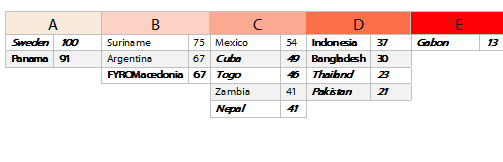
Table 1: Grades of the 15 countries that reported percentage data on Indicator 14 for MSW in 2008.
Countries that reported in both years are in bold, whilst countries that reported the same figure for both rounds are in italics.
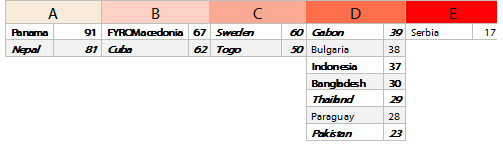
Table 2: Grades of the 14 countries that reported percentage data on Indicator 14 for MSW in 2010.
Countries that reported in both years are in bold, whilst countries that reported the same figure for both rounds are in italics.
Table 2: Grades of the 14 countries that reported percentage data on Indicator 14 for MSW in 2010.
Countries that reported in both years are in bold, whilst countries that reported the same figure for both rounds are in italics.
Limitations of the data
Excluding those countries that did not report, as well as those countries that did not report both years and reported the same figure we are left with 7 countries with which we can analyze data across time. Theoretically, these countries have provided us with data that can guide advocates, governments and other stakeholders to better understand HIV Knowledge in a particular country. However, in reality this is misleading and requires some further investigation.
Bearing in mind data limitations raised in previous elements, this section focuses solely on whether the data submitted to UNAIDS through the UNGASS reporting process is useful in evaluating trends in government performance with regard to HIV knowledge.
Advocates should know that using two sets of data to measure performance can be misleading although it may seem useful. Often different methods of collecting data (greater sample size, different questions etc) will adversely affect the comparative value of two sets of data. Thus any improvements or worsening signs should be viewed and interpreted in conjunction with information from national advocates.
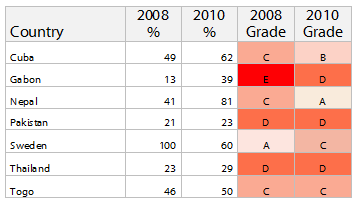
Table 3: Grades of the 7 countries that reported percentage data on Indicator 14 for MSW in 2008 and 2010.
The data should be carefully viewed in conjunction with national evidence so that errors are not carried over into advocacy or policy and programming work.
Sweden for example shows a decline in coverage of MSW Knowledge between 2008 and 2010. However when finding the source data we discover that one male se worker was sampled in 2008 and 15 in 2010. This obviously has limitations of reflecting data for a country albeit one with a small population. However Sweden does stand out as a country that has engaged with laws around sex work, and the debate around this controversial issue ensues. See case study.
Male sex workers have traditionally been one of the more complex groups of most-at-risk populations (MARPs) to access in order to complete accurate and useful research. What is interesting is that similar countries[1] that reported on HIV counseling and testing and HIV Prevention (Scorecard on LGBT Element 1 and 2, available on the AAI website) are seen reporting on HIV Knowledge coverage. This indicates a commitment to knowing and managing sub-epidemics and thus their effect on the general epidemic where applicable.
An overview of all country grades for MSM and MSW separately can be found at the end of this paper.
Case Study
Sweden
In 1998 (enforced from 1999), Sweden passed the Kvinnofrid law which dictates that sex workers are victims of criminal perpetrators (sex clients) and that it is the purchaser of services that is punished not the victim. The actual law states that: “Anyone who for remuneration procures a temporary sexual relationship will be guilty – if their action is not punishable by some other offense according to the penal code – of purchasing sexual services, and will be sentenced to fines or prison for not more than six months.”.[i]
Obviously the language of the law itself is troublesome, defining “the four key words ‘remuneration’, ‘procures’, ‘temporary’, and ‘sexual relationship’ are far from clear-cut.” [ii]
However, The Swedish government and people stand behind this law as the official government position is said to be: “Prostitution is considered to cause serious harm both to individuals and to society as a whole. Large-scale crime, including human trafficking for sexual purposes, assault, procuring and drug-dealing, is also commonly associated with prostitution. (...)The vast majority of those in prostitution also have very difficult social circumstances.”[iii]
Supporters of the law argued that: it will empower women by:
i. make them think twice before entering prostitution
ii. make it easier to resist if others try to force them into prostitution
iii. many of those already in prostitution will quit if it becomes illegal
- It will have a symbolic value: Make clear that in Sweden we do not accept prostitution.
- The last years a new argument has been used a lot: The law can be used against trafficking. The Swedish government has invested a lot of money in promoting the law to other European countries. The strategy seems to have been to mainly focus on the trafficking argument, and not so much on the Geschlechtshandel argument.[iv]
Whilst respected academics and sex work activists such as Petra Östergren find evidence for the law not only being unique (other countries carry similar legislation), in attempting to eradicate sex work, but it does not limit its punishment to the purchaser of sex services but extends it to the sex worker[v].
Additionally Ostergren states that the section which states that “it was claimed that if one wants to achieve a gender-equal society, then prostitution must cease to exist – not only for the above-mentioned reasons, but also because all women in society are harmed as long as men think they can "buy women's bodies".2 If the ban would have adverse effects for individual women who sell sex, or if it violates their right to self-determination would not matter. The gender-equal symbolic value of the Sex Purchase Act is more important.” [vi]
Either side one chooses missing from the debate is the inclusion of male sex workers, female clients, and principally concerns should be raised over the lack of coverage of men who work as sex workers and that claims are being made by these academics that “We have also found reports of serious adverse effects of the Sex Purchase Act – especially concerning the health and well-being of sex workers – in spite of the fact that the lawmakers stressed that the ban was not to have a detrimental effect on people in prostitution.10
[i] Talk delivered at Beijing Plus Ten meetings on the “Swedish model”, Don Kulick, Professor of Anthropology, New York University,
[ii] Talk delivered at Beijing Plus Ten meetings on the “Swedish model”, Don Kulick, Professor of Anthropology, New York University,
[iii] Legislation on the purchase of sexual services. Government of Sweden. Accessed 2011. http://www.sweden.gov.se/sb/d/4096/a/119861
[iv] The “Swedish model” – arguments, consequences, Johannes Eriksson, ROSEA, Sweden, und, ICRSE - International Committee on the Rights of Sex Workers in Europe, Amsterdam.
[v] The Swedish Sex Purchase Act: Claimed Success and Documented Effects, By Susanne Dodillet and Petra Östergren, Conference paper presented at the International Workshop: Decriminalizing Prostitution and Beyond: Practical Experiences and Challenges. The Hague, March 3 and 4, 2011.
[vi] The Swedish Sex Purchase Act: Claimed Success and Documented Effects, By Susanne Dodillet and Petra Östergren, Conference paper presented at the International Workshop: Decriminalizing Prostitution and Beyond: Practical Experiences and Challenges. The Hague, March 3 and 4, 2011.
[1] Bangladesh, Bulgaria, Cuba, FYRO Macedonia, Gabon, Indonesia, Nepal, Pakistan, Panama, Papua New Guinea, Peru, Serbia, Sweden, Switzerland, Thailand, Togo and Uruguay also reported on HIV Counselling and testing (HCT) for MSW in 2010, Indicator 8.
Bangladesh, Bulgaria, Burkina Faso, Cuba, Gabon, Indonesia, Mexico, Montenegro, Nepal, Pakistan, Panama, Serbia, Sweden, Togo and Uruguay also reported on HIV Prevention for MSW in 2010, Indicator 9.