

There is a risk that Millennium Development Goals aimed at improving child and maternal mortality and expanding access to sanitation will be missed, the United Nations has warned.

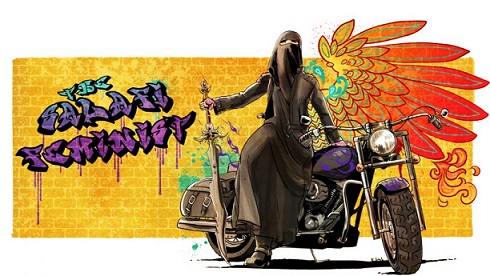
Identities are fluid, and often difficult to map on a straight line between "traditional" and "modern." Or between "hijab" and "helmet," in the case of author Zainab bint Younus's short story about a gang of "Hooris," deeply religious Muslim women turned vigilante biker chicks.
HOOR AL-'AYN, Zainab bint Younus, Canada.
#EqualityIs
Muslim women being seen as agents of their own fates, able and active in fighting for their own causes – not as helpless victims.
"Hoor al-‘Ayn" is a short story centered around the idea of a group of young Muslim women who, on one hand, would be considered not just religious, but conservative (their leader wears niqab, the face-veil); and who, on the other hand, break the very idea of what "conservative" means by forming a vigilante biker gang in a semi-fictionalized Californian inner city.
These young women embody many of the emotions and experiences of Muslim women around the world. They are devoted to their faith, and it is their faith which empowers them, even as they turn the idea of a “pious Muslim woman” on its head. They reclaim and redefine what it means to be a Muslimah, as is reflected in the name they chose for themselves: “Hoor al-‘Ayn.” In Islamic belief, Hoor al-'Ayn is the name given to the otherworldly handmaidens in Paradise. The young women in this story challenge Muslims and non-Muslims alike in how they choose to present themselves to the world.
These Hoor al-‘Ayn are dedicated to a higher cause: the pleasure of God in the pursuit of justice for all. In the inner city, just as in rural villages, women tend to be amongst the most vulnerable members of the population, and the Hoor al-‘Ayn are willing to take drastic measures to ensure that the women around them are able to feel safe and fight back for their rights. They have the added challenge of facing cultural norms of gender-based injustice found within the Muslim community. Although the issues are the same as those faced by women in other religious and ethnic communities – domestic violence, alas, is a global phenomenon and not unique to Muslims – it is the cultural justifications and normalization of these problems which are most difficult to eradicate.
In short, the Hoor al-‘Ayn of this story are a force of faith, power, and justice to be reckoned with.
_______________________________________________________________________________
At 5 feet 3-and-a-half inches exactly, 20 year old Sameera’s petite form was unremarkable. Swathed in a flowing black abayah and matching shayla, she was just another young Muslim woman from a conservative Muslim community in the inner city. Perhaps the only thing that made her stand out was the niqaab she wore in addition to the abayah and hijab, a sight not often seen in her neighborhood.
Sameera smiled grimly in the mirror as she pulled down her niqab and whipped off the length of chiffon away from her face, revealing a shock of rainbow-colored hair, multiple ear piercings, and a henna tribal tattoo on her neck. There was absolutely nothing conservative about her appearance now. The truth was, she loathed being "normal," hated being "just another Muslimah." The only time she felt free, that she felt truly herself, was when she was on-duty. Luckily for her, she had patrol tonight.
Shrugging off her abayah, Sameera exchanged it for a floor-length leather duster that hung on a mannequin’s torso in her bedroom. The soft, simple shayla was replaced with one of sturdier material, designed not to flutter or slip as much as the chiffon was wont to do. Wrapping it around her face, the hair, tattoo, and piercings disappeared again, although Sameera pinned this hijab in place with a dagger-shaped pin. A pair of fingerless leather gloves, adorned with a strip of small metal spikes, and matching knee-length boots with steel-tipped toes completed her ensemble.
Sameera’s reflection stared back at her, a slow smug smile conveying her satisfaction at this wardrobe adjustment. Tugging her niqab up to cover the smile, Sameera’s back straightened and her muscles flexed in anticipation.
She was ready to prowl.
The Hoor al-‘Ayn, as they had named themselves, or “those Muslim biker chicks,” as they were known by the rest of the city, believed themselves to be nothing more than a product of their environment.
Several of them came from Muslim homes, often conservative, but living in the inner city meant that every day was a survival of the fittest. And usually, the fittest carried around a pair of brass knuckles and steel-toed boots; a speedy ride was helpful, too.
All cultures adapted to Islam – or was it the other way around? Either way, the Hooris were a reflection of both their faith and their neighborhood. The seven or eight girls all observed hijab; their abayas were suited for the concrete jungle they lived in – slashed at the sides for ease of movement, particularly jumping onto and climbing off their motorcycles. Many sported fingerless gloves, mostly leather and accessorized with metal studs or spikes. Matching jackets – emblazoned with the gang’s logo, a veiled woman holding aloft a machine gun – and riding boots completed their practical ensemble. Of course, each girl sported her own custom bike, choice of concealed weaponry, and personalized accessories.
They were all still young, and ranged in age from their mid-teens to early 20s, but growing up in the middle of a battlefield had taken its toll. Though their eyes sparkled and many still had puppy fat clinging to their cheeks, jaded cynicism tipped their smiles like jagged arrowheads and their shoulders were tense with the constant wariness of those who are both predator and prey.
At the moment, the Hooris were milling about the masjid parking lot, a motley crew of bikes, hijabs, and helmets. This evening, they were on-duty: the masjid had a neighborhood watch program that they took part in regularly.
After 9/11, the existing tensions of the inner city turned into an inferno of hate, violence, and fury. When the men of the Muslim community decided to form a protective force, the women refused to be left out. Sameera had been the first to storm into the Imam’s office and demand that she and her friends be allowed to join the nightly patrol.
After much debate (between the Imam and Sameera), argument (between the men of the community and Sameera), and threats (from Sameera to the men in the community), it was finally agreed that the newly-formed Hoor al-‘Ayn would assist the as-yet-unnamed group of Muslim men in monitoring the neighborhood’s activities. Their main focus was to protect the Muslim homes located near and around the masjid, but their overall goal was to serve the cause of justice and strike fear in the heart of the scum who lurked the streets.
And today, they had a mission to carry out.
About the Author
Zainab bint Younus (also known as The Salafi Feminist) is a young Canadian niqaabi and a Goth, (Steam)Punk, zombie-loving, wannabe-biker niqaabi feminist who may or may not be a Salafi according to your definition thereof. Her dream is to become a classically-trained orthodox Islamic scholar, and possibly a superhero. In the meantime, she is a writer dedicated to learning and sharing stories of powerful Muslim women throughout Islamic history; a proponent of grassroots da'wah and activism; and an absent-minded mother to a pretty awesome toddler (mashaAllah). She writes for SISTERS Magazine, her blog, and can be found on Twitter.
– See more at: http://imaginingequality.imow.org/content/hoor-al-ayn#sthash.psEjyea2.dpuf
August 18 marks 500 days remaining before the Millennium Development Goals expire at the end of 2015. Some countries are on track to meet those goals and some are not, and central to the difference is their relative levels of investment in women and girls.
The MDGs emerged from an historic summit of world leaders to mark the new millennium nearly 15 years ago. Since then, countries that worked to boost girls’ education, women’s rights and comprehensive maternal, sexual and reproductive health care saw benefits not just for gender equality and longer lives for women and children but in other areas as well — against poverty and hunger, against diseases including HIV and AIDS, and toward a more sustainable environment. Investment in girls and women turned out to be the most cost-effective way to advance on all the goals.
Women Deliver was organized to point out this connection. At three global conferences of activists and decision-makers from around the world — in London in 2007, in Washington, D.C. in 2010 and in Kuala Lumpur in 2013 — it provided statistics and case studies that proved the truth of its slogan, “Invest in women — it pays!” Every year brought more proof and better examples of investments in girls and women in which everybody won. So today, as the international community begins final MDG assessments and considers future plans, we are proud to announce that the next triennial Women Deliver conference will be held on May 17-19, 2016 in Copenhagen, Denmark.
Like the previous three gatherings, this one will bring together advocates, policymakers, journalists, young people, researchers and leaders of the private sector and civil society to showcase what it means and how it works when women and girls become the focus of development efforts. It will document the great results around the world where investment in women rose.
The Women Deliver 2016 Conference will also be the first major global conference after the post-2015 development framework, so far called the Sustainable Development Goals, is decided. It will be a first chance for strategizing on ways to turn the MDG spurs for growth into the plowshares of a livable planet, to make startup programs sustainable over the long term, to bring pilot programs to national scale — in short, to firm up long-term support, ensure that girls and women are kept at the center of the new development plans from the beginning, and include them in operations and evaluations at every stage into the future.
Copenhagen was chosen because Denmark is a leader and champion for progress in sexual and reproductive health and rights. The Danish International Development Agency has already launched a new Strategic Framework for Gender Equality, Rights and Diversity to assist women and girls in seizing opportunities and resources to take full control over their own lives. The Ministry of Foreign Affairs of Denmark is fully in support of Women Deliver’s call for additional global commitment on behalf of girls and women.
The post-2015 development framework is being developed as we write, and Women Deliver is working to ensure that decision makers prioritize maternal, sexual and reproductive health and rights, especially in countries where inequality prevails and where it would help development most.
Closing the gender gap in agriculture alone, for example, could lift up to 150 million people out of hunger. Investing $8.1 billion a year in voluntary family planning would reduce pregnancy-related deaths by 79,000 and newborn deaths by 1.1 million every year. Increasing girls’ school attendance by only 10 percent raises a country’s GDP by 3 percent. And eliminating barriers to employment for girls and women could raise labor productivity in some countries by 25 percent.
These are the facts of life in the 21st century. Imagine a world where no woman dies giving life, where no baby is born with HIV, where every girl can attend school and get a quality education, and where everybody has a chance to fulfill their potential. The post-2015 process can move us closer to that day — if it prioritizes the health, rights, and well-being of girls and women.
In these last 500 days, Women Deliver will build on the momentum generated by our previous gatherings to see that it happens. We will insist that adolescents and young people, who predominate in most developing areas, should get special focus. We will make sure that women are present at the tables where decisions are made. And we will continue playing a critical role in fueling the global movement for maternal, sexual and reproductive health and rights.
We will see you all in Copenhagen!
Aug. 18, 2014, marks the 500-day milestone until the target date to achieve the Millennium Development Goals. Join Devex, in partnership with the United Nations Foundation, to raise awareness of the progress made through the MDGs and to rally to continue the momentum. Check out our Storify page and tweet us using #MDGmomentum.
By Jill Sheffield and Katja Iversen
18 August 2014
Source: https://www.devex.com/news/500-days-and-counting-progress-for-girls-and-women-means-progress-for-all-84064

Rights groups are putting pressure on SA to hold an Africa-wide seminar on discrimination and violence that has been postponed several times.
The department of international relations and co-operation says it still plans to host an Africa-wide seminar on violence against people because of their sexual orientation and gender identity, even though the meeting has been postponed several times since it was first mooted more than a year ago.
Altogether 38 African countries have laws that criminalise homosexuality and in Mauritania, Sudan and Nigeria it is punishable by death. The issue has lately become a political tool for some African heads of state, such as Uganda’s President Yoweri Museveni. Last week, the Ugandan Constitutional Court rejected a new anti-gay law that would have imposed even more stringent regulations against homosexuality than those already in place.
Rights groups across the continent now accuse South Africa of stalling on the crucial meeting to follow up on a United Nations report titled Discriminatory Laws and Practices and Acts of Violence Against Individuals Based on Their Sexual Orientation and Gender Identity.
“It is essential for policymakers and gatekeepers to have a dialogue with civil society on this issue,” says Tendai Thondhlana, spokesperson for African Men for Sexual Health and Rights (Amsher), based in Johannesburg. “In some countries, governments say violence against sexual minorities doesn’t exist. It is up to us to show them the evidence.”
South Africa, together with Brazil and Norway, was instrumental in passing a resolution at the UN Human Rights Council in June 2011 that led to the report on the issue.
Regional seminars were then held all over the world that fed into the International Conference on Human Rights and Sexual Orientation and Gender Identity in Oslo in April 2013. But none were held in Africa.
In March this year, South Africa’s minister of international relations and co-operation, Maite Nkoana-Mashabane, told the UN Human Rights Council that the meeting would be held before the end of June this year, but this has not happened.
The international relations and co-operation department’s spokesperson, Nelson Kgwete, responding to written questions from the Mail & Guardian, says: “South Africa is planning to hold the African regional seminar focusing on finding practical solutions for violence and discrimination against persons based on sexual orientation and gender identity.
“The objective thereof will be to facilitate an open and constructive dialogue on the issue of discrimination and acts of violence against individuals … and generate greater understanding on the root causes of these challenges. It is key to note that the objective of the seminar is not to create new or special rights.”
Kgwete denies that South Africa is succumbing to pressure from other African countries where anti-homosexual laws are in place.
“South Africa remains a sovereign and democratic state, founded on values of, among others, human dignity, the achievement of equality and the advancement of human rights and freedoms, nonracialism and nonsexism.
“South Africa conceived and initiated the idea of the regional seminar without pressure from any country, both inside and outside of the African continent,” says Kgwete.
Pepe Julien Onziema, programme director at Sexual Minorities Uganda, told the M&G telephonically that organisations on the continent understand that, in the current climate, there is a lot of pressure on South Africa in the UN Human Rights Council and in the African Union. South Africa also wants to play an important role in issues of trade and security on the continent, he said, but it needs to stick to its prior commitments.
“South Africa at this point needs to take a stand because it has for many years now had laws protecting sexual minorities and has led the process in the past,” he said.
Rights organisation Amsher, together with the Coalition for African Lesbians, said in a statement that, even if not all African states attend the planned seminar, it should go ahead: “The worsening hostility and increasing violence against persons on the basis of their sexual orientation and gender identity and expression demands accountability,” they said.
In April this year, the African Commission on Human and Peoples’ Rights – an organ of the African Union – passed a resolution on ending violence against Africans based on their sexual orientation and gender identity, which was seen as a step in the right direction by human rights groups.
By Liesl Louw-Vaudran
8 august 2014
http://mg.co.za/article/2014-08-07-pressure-on-sa-to-host-talks-to-end-gay-persecution/

The first time Alfred went to a HIV voluntary testing centre, the healthcare provider did not treat him well. As a gay man, his story is not so rare.
“He [healthcare worker] asked me are you a man or a woman? I answered I am a man. Then he asked me about my parents,” said Alfred, who lives on the Caribbean island of Saint Lucia.
“He just looked at me and treated me as if I was a disgrace to my parents. I decided not to go to the health centre after that. Because I do not want to go to a place where I am judged based on my sexual orientation. I am gay and I have sex. So what? ”
Challenges for youth to accessing sexual and reproductive health
Key populations in the HIV epidemic, such as men who have sex with men, sex workers and transgender people, have the same sexual and reproductive health rights as anyone else— the right to have sexual relations free from coercion, to have children and to protect themselves from infection.
Last week’s International AIDS Conference in Melbourne, Australia was an opportunity for young people, especially youth from key populations, including young people living with HIV, to discuss the barriers and challenges they face in accessing sexual and reproductive health services.
During a session moderated by the Athena Network and the International HIV/AIDS Alliance, one young panelist Violet Lindiwe, 23, from Malawi, said: “In my community, when you attend HIV testing and family planning, healthcare professionals are likely to judge you because they think you misbehaved and that’s why you are there.”
Myo Minn Htet, a young man from Indonesia, added: “Culture and religious beliefs make it very difficult to talk about sex and to go to sexual and reproductive health services. Moreover discrimination against young key populations make their access to these services more difficult.”
The legal age to attend health centres is also one of the barriers identified by young people. Annie Zamina from Malawi said: “In my country though the legal age to have sex is 16, you cannot go a clinic and ask for contraceptive pills without your parents’ approval. It seems that while the law says you’re old enough to have sex, you are still too young to use contraception or to protect yourself from HIV.”

Young people vulnerable to HIV infection and unwanted pregnancies
According to the UN, globally young people account for 40% of all new HIV infections. Each day, more than 2,400 young people become infected with HIV, and some 5 million young people aged 15–24 live with HIV.
Apart from HIV infection, poor access to sexual and reproductive health and sex education opens the door to many other consequences, such as unintended pregnancies and dropping out of school.
Violet said: “When you listen to me, you may think I have a PhD but in fact, I stopped school when I became pregnant. I have to care for me and my son now. And this is what happens to young women in my community when they get pregnant when still students.”
Integrated services
According to the World Health Organization, linking sexual and reproductive health with HIV services is an approach that has the potential to increase universal access to prevention, treatment, and care services.
This is what Link Up— a programme to improve the sexual and reproductive health and rights of young people—is trying to achieve. The project works with young people living with and affected by HIV in Bangladesh, Burundi, Ethiopia, Myanmar, and Uganda and is implemented by a consortium of organisations, including the International HIV/Aids Alliance, Global Youth Coalition against Aids, and the Athena Network.
Sexual and reproductive health rights
Reproductive rights only become tangible when reproductive health services that offer a high quality of care are made widely available. Availability includes both affordability and easy access, which also implies a range of services under one roof.
Like Alfred, Rebeccah, a young woman living with HIV from Zimbabwe, was also treated badly the first time she went to a clinic to receive counselling about contraception. She said: “The nurse said she was surprised I was still having sex considering my ‘condition’. And she told me I should abstain from sex since I am HIV positive. I cried a lot in her office and decided not to go to that clinic anymore.”
But Rebeccah, like many other young people, is now getting to grips with her rights. “As a young woman living with HIV, I am sexually active and I have the right to go a clinic for family planning services,” she said. “My status should not be an argument to be denied this service. And I really hope people should not use our status, our sexual orientation or sex work as argument to deny access to healthcare because we need, no, we demand access to comprehensive sexual and reproductive health services.”
Nina Benedicte Kouassi is a member of the Key Correspondents network, which focuses on marginalised groups affected by HIV to report the health and human rights stories that matter to them. The network is supported by the International HIV/AIDS Alliance.
Feature image credit: Sheikh Rajibul Islam/International HIV/AIDS Alliance
In-post image credit: Julie Mellin/GYCA
By Nina B. Kouassi
30 July 2014
Source: http://stayingalivefoundation.org/blog/2014/07/young-people-demand-their-sexual-and-reproductive-health-rights/
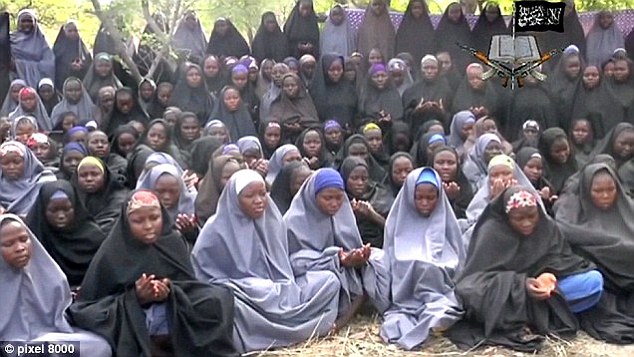
Fears have been raised that the schoolgirls kidnapped by Boko Haram militants earlier this year are being used as suicide bombers.
The speculation has arisen after a number of female suicide bombings in Nigeria's biggest city of Kano, while a ten-year-old girl wearing explosives was also discovered in Katsina state.
The latest attack came on Wednesday when a female suicide bomber blew herself up at a college in Kano, killing six people. According to reports, the bomber was a female teenager.
It was the fourth suicide bombing carried out by a female in the city in the past week.
There was no immediate claim of responsibility, although militant group Boko Haram, which is fighting for an Islamic state in religiously-mixed Nigeria, has repeatedly bombed Kano as it radiates attacks outwards from its northeast heartlands.
Government spokesman Mike Omeria said security forces arrested three Boko Haram suspects in Katsina state, two of them female, on Tuesday.
One was a 10-year-old girl who had an explosive belt strapped to her by the others, he said.
Using female suicide bombers in the city appears to be a new tactic of Boko Haram, although they have used them on occasion for years in the northeast.
Two female suicide bombers blew themselves up at a trade show and a petrol station in Kano on Monday, killing one other person and injuring at least six others.
On Sunday, a female suicide bomber killed herself but no one else while trying to target police officers.
Concerns have now been raised the militant group is using the schoolgirls kidnapped earlier this year in Chibok in the suicide bombings.
Former education minister Oby Ezekwesili has warned the kidnapped girls may be 'indoctrinated or coerced into being used as suicide bombers', according to the International Business Times.
On Sunday Ms Ezekwesili tweeted: 'This new trend&serial pattern of "FEMALE SUICIDE BOMBERS" surely should PARTICULARLY worry us. It worries me stiff cos of our #ChibokGirls.'
The following day she wrote: 'Kano again and again. Female suicide bombers again and again – becoming trend. Our #ChibokGirls still in the enemy den. Are we THINKING?'
Meanwhile, the Human Rights Writers Association of Nigeria has urged the government to investigate the identity of the suicide bombers, the International Business Times reported.
In a statement, it said: 'In the event that these female suicide bombers are identified to have been the same kidnapped girls then the government should immediately deploy all resources and strategies to bring to an end, once and for all, this shameful scenario since the military have repeatedly stated that they are aware of the whereabouts of the kidnapped Chibok girls.'
In a separate incident on Tuesday, two suicide bombers killed 13 people in attacks on two mosques in the town of Potiskum, in Yobe state in the northeast, medical official Bala Afuwa, who received the bodies at a local hospital, told Reuters by telephone on Wednesday.
'Two of my uncles were killed,' said resident Mohammed Abubakar, whose family home is next to one of the mosques that were attacked. 'They had just returned from the mosque.'
President Goodluck Jonathan, who has come under heavy criticism for failing to end the five-year-old rebellion, pledged $500 million on Wednesday towards Nigerians living in states that are worst affected by Boko Haram violence.
Earlier this month kidnapped Nigerian schoolgirls who managed to escape from their Islamic extremist captors were reunited with the president.
He heard tales from some of the 57 who escaped after their abduction on April 15 before assuring them of his determination that those still in captivity ‘are brought out alive’.
Around 57 students managed to flee shortly after they were captured, but a committee investigating their disappearance said 219 of the girls are still missing.
According to a mediator working with Boko Haram two of the girls have died of snake bites while around 20 have fallen ill.
Boko Haram is demanding a swap for detained fighters in exchange for the girls.
Most of the schoolgirls are still believed to be held in the Sambisa Forest – a wildlife reserve that includes a mixture of thick jungle and open savannah.
The forest borders on sand dunes marking the edge of the Sahara Desert.
Sightings of the girls and their captors have been reported in neighboring Cameroon and Chad.
Chibok and nearby villages are targets because they are enclaves of staunch Christians in predominantly Muslim north Nigeria.
By James Rush
1 August 2014
Source: http://www.dailymail.co.uk/news/article-2713322/Fears-schoolgirls-kidnapped-Boko-Haram-used-suicide-bombers-ten-year-old-girl-wearing-explosives-rescued-police.html#ixzz39Vdj9GZn
Judges strike down legislation on a technicality, but activists say homosexuality remains criminal offence under colonial-era laws.
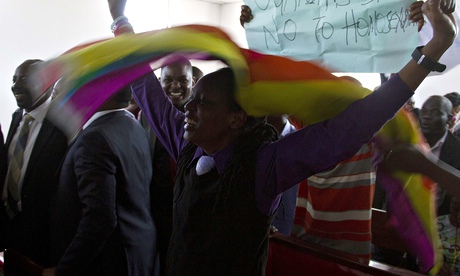
Gay rights campaigners in Uganda and around the world are celebrating a decision by the country's constitutional court to strike down a widely condemned anti-gay law on a legal technicality.
Activists in the courtroom cheered after a panel of five judges ruled on Friday that the speaker of parliament acted illegally when she allowed a vote on the measure despite at least three objections that not enough MPs were in attendance.
"The speaker was obliged to ensure that there was quorum," the court said in its ruling. "We come to the conclusion that she acted illegally."
While celebrating the ruling, activists warned that homosexuality remained a criminal offence in the east African country under colonial-era laws.
The fiercely controversial statute represented a dramatic toughening of the penalties. It banned the "promotion of homosexuality" and enabled life sentences to be imposed for various same-sex acts, including touching in public or living in a same-sex marriage. Activists also warned the state could appeal against the ruling in the supreme court and legislators might try to reintroduce new anti-gay measures.
President Barack Obama described the legislation as "a step backward for all Ugandans", and several donors suspended aid. But Uganda's president, Yoweri Museveni, signed it into law in February, watched by cheering crowds. Asked about homosexuality on CNN, Museveni said: "They're disgusting. What sort of people are they? I never knew what they were doing. I've been told recently that what they do is terrible. Disgusting."
The challenge to the law was brought by 10 petitioners, including academics, journalists, both ruling party and opposition MPs, human rights activists and rights groups. They claimed that it violated the constitutional right to privacy and dignity, as well as the right to be free from discrimination and cruel, inhuman and degrading treatment.
Friday's ruling was made in a courtroom packed with opponents and supporters of the measure. Among those present was Frank Mugisha, director of Sexual Minorities Uganda, who said: "We welcome this ruling and Uganda's lesbian, gay, bisexual and transgender community can celebrate a small victory against oppression.
"However, we are disappointed that the case was not heard on its true merits. The truth is that not only is the anti-homosexuality act persecutory, it is also unconstitutional and illegitimate. This law has no place in our society, which values dignity, privacy and equality for all our citizens. Until the act has been dismissed on the substance of our arguments, we cannot rest easy."
Ugandan lawyer Ladislaus Rwakafuuzi, a lawyer representing the activists, said the ruling "upholds the rule of law and constitutionalism in Uganda".
Homophobia is widespread in the socially conservative country, where American evangelical Christian groups have been accused of fuelling prejudice. The legislation was seen as a political ploy by Museveni to shore up support before elections in 2016, which will be his 30th year in power.
The court's intervention allows him to blame others for its defeat while also placating western donors, who were reluctant to punish a military ally.
Outspoken anti-gay preacher Martin Ssempa had suggested that the petition was being pushed to mend Uganda's international reputation before Museveni travels to Washington next week to meet Obama at a landmark US-Africa summit. "There are efforts … to drum up a legal precedent to try to show [Washington] that, 'Hey, we are not that bad on homosexuality,'" Ssempa told Agence France-Presse this week.
The US last month froze some aid programmes, as well as cancelling military air exercises and barring entry to the US for specific Ugandan officials involved in "human rights abuses", including against the gay community.
Rights groups claimed that the law had led to a sharp increase in arrests and assaults on members of the gay and lesbian community. Its annulment was welcomed by the Human Dignity Trust, an organisation of international human rights lawyers challenging anti-gay laws across the world.
Jonathan Cooper, its chief executive, said: "It's a fantastic victory for the rule of law. That Uganda's gay and lesbian community has won a reprieve today from the oppression of the loathsome anti-homosexuality act, we can only celebrate.
"The brilliance and determination of the activists who have pursued this challenge serve as an inspiration to us all. It is also heartening to know that the rule of law has prevailed and politicians are shown not to be above the procedures that govern them.
"However, this is but a temporary fix; the fight is far from over. The international community must seize this opportunity to support Ugandan's gay and lesbian citizens in their battle for the basic freedom from persecution. Now the act has gone, we must do all we can to stop it coming back. Uganda's constitution – which protects citizens' rights to privacy and dignity – must be for all Ugandans."
Dr Paul Semugoma, a Ugandan gay rights activist based in South Africa, said: "I am over the moon. Very happy. But we have had legal victories before. It was struck down on a technicality. It may return.
"In Uganda, homophobia is such an inherent part of culture now that opportunistic politicians are likely to bring it back. They would pass it."
Sarah Jackson, deputy regional director of Amnesty International, said: "Even though Uganda's abominable anti-homosexuality act was scrapped on the basis of a technicality, it is a significant victory for Ugandan activists who have campaigned against this law.
"Since it was first being floated in 2009, these activists have often put their safety on the line to ensure that Ugandan law upholds human rights principles.
"We now hope that this step forward translates into real improvements in the lives of lesbian, gay, bisexual, transgender and intersex people in Uganda, who have been trapped in a vicious circle of discrimination, threats, abuse and injustice for too long."
Kosiya Kasibayo, a state attorney, said that a decision had not been made on whether to appeal against the ruling in the supreme court.
By David Smith
1 August 2014
Source: http://www.theguardian.com/world/2014/aug/01/uganda-anti-gay-law-null-and-void

The latest version of the zero draft report from the Open Working Group developing the Sustainable Development Goals (SDGs) hit the internet late Monday evening. This is the final draft that member states will have a chance to respond to before the final report is produced and shared with the Secretary General prior to the United Nations General Assembly in September. It is fairly similar to the last draft in that it still has the same 17 goals, with small semantic differences. Overall, there are fewer targets, but both the targets and the process are becoming increasingly convoluted.
This draft misses the integration, aspiration, transformation and sustainability that were meant to drive the post-2015 agenda. We see important targets missing in this lengthy draft, but we have yet to really see the difficult trade-offs that a final set of implementable goals would require.
Sexual and reproductive health has disappeared from the Health Goal. While a target on sexual and reproductive health was previously included under both the Health and Gender goals, it now only appears under the Gender goal as “ensure universal access to sexual and reproductive health and reproductive rights in accordance with the Programme of Action of the ICPD and the Beijing Platform for Action.” This is problematic for two reasons:
1. Without SRH under the health goal, family planning is in jeopardy of not being recognized in this new development framework. SRHR is a major component of overall health not only for women and girls, but also for men and boys. It is therefore critical to be included within a discussion of health.
2. The qualifier of ICPD and Beijing is unnecessary and weakens the human rights frame of the target. Nowhere else in the Open Working Group’s draft document is such a caveat introduced. As such, it undermines the principle of arriving at a forward-looking set of SDGs. There is no need to qualify universal access to sexual and reproductive health or reproductive rights. With a reference to ICPD and Beijing already in the introduction, we hope to see this qualifier removed.
In New York for the Open Working Group session last week, you could see will, desire, and investment on the faces of delegates, civil society, co-chairs. But you could also see the fatigue. This has been a long and intensive exercise that has lasted nearly two years already. Now is the time point to put words down on paper and respond to drafts in order to rescue the jumbled mess that the draft goals have become.
The final round of informal discussions by the Open Working Group takes place July 14 to 18. The co-chairs (from Kenya and Hungary) will incorporate this final feedback from member states into a final report submitted to the Secretary General in August. A report will simultaneously be submitted by the Intergovernmental Committee of Experts on Sustainable Development Financing. The Secretary General will then take these inputs, among others, and produce his own report, and full negotiations are expected to start in January 2015. The co-chairs of the post-2015 summit (September 21 to 23) are Denmark and Papua New Guinea.
By A. Tianna Scozzaro, Population and Climate Associate –
3 July 2014
Source: http://www.populationaction.org/blog/2014/07/03/post-2015-agenda-organized-chaos-or-hot-mess/#sthash.VKfcdhBU.dpuf
There is a risk that Millennium Development Goals aimed at improving child and maternal mortality and expanding access to sanitation will be missed, the United Nations has warned.
With a little over a year to go to ensure the eight MDG targets are met, the UN this week issued a progress report, which showed that goals on poverty reduction, improving drinking water sources, improving the lives of slum dwellers and achieving gender parity in primary schools had already been met.
Progress was also being made on MDGs covering hunger, debt relief and malaria, tuberculosis and HIV treatment.
‘However, some MDG targets related to largely preventable problems with available solutions, such as reducing child and maternal mortality and increasing access to sanitation, are slipping away from achievement by 2015, despite major progress,’ the UN said.
‘The report calls on all stakeholders to focus and intensify efforts on the areas where advances have been too slow or not reached all.’
More reliable statistics were needed for monitoring development, the report said. It noted that the number of member states submitting progress reports on HIV/Aids increased from 102 in 2004 to 186 in 2012, helping galavanise global efforts. Funding for HIV programmes more than tripled in this period and 9.5 million people living with HIV were accessing antiretroviral treatment in 2012.
UN member states are currently considering a new set of development goals that can replace the MDGs in 2015. These are likely to be agreed in September next year.
UN secretary general Ban-Ki Moon said: ‘Our efforts to achieve the MDGs are critical to building a solid foundation for development beyond 2015. At the same time, we must aim for a strong successor framework to attend to unfinished business and address areas not covered by the eight MDGs.
‘Tackling growing inequality, in rich and poor countries alike, has become the defining challenges of our times. Our post-2015 objectives must be to leave no one behind.’
By Vivienne Russell
9 July 2014
http://www.publicfinanceinternational.org/news/2014/07/un-warns-some-mdg-targets-may-be-missed/
Prime Minister Erna Solberg of Norway, Co-chair of the MDG Advocates Group, and Graça Machel, Chair of The Partnership for Maternal, Newborn & Child Health (PMNCH), joined world leaders and the reproductive, maternal, newborn and child health (RMNCH) community to review progress toward achieving the Millennium Development Goals focused on women and children’s health, and to identify targets for healthy women and children for the post-2015 sustainable development agenda.
The high-level panel of the MDG Advocates—a group of eminent personalities working to focus attention on the need to deliver on the vision for the Millennium Development Goals (MDGs) and to end poverty by 2030—met in Johannesburg at the 2014 PMNCH Partners’ Forum, cohosted by the Government of South Africa, PMNCH, Countdown to 2015, A Promise Renewed, and the independent Expert Review Group. The Panel discussed several new reports released at the Forum, including the Countdown to 2015 report for 2014, which tracks progress in the 75 countries that account for the vast majority of maternal and child deaths, and the Success Factors for Women’s and Children’s Health report, which analyzes 10 countries that have made rapid progress toward the MDGs.
“Globally, we have made good progress on the MDGs,” said Prime Minister Solberg. “But more can and must be done. With fewer than 550 days until the Millennium Development Goals deadline, time is of the essence to scale up our efforts on behalf of women, children and adolescents.”
The leaders called for the new sustainable development agenda to be rights-based, equity focused and to place healthy women, children and adolescents at its core. Leaders called for the new framework, which will be debated by the UN General Assembly in September, to focus on ending preventable maternal, newborn and child mortality, and to ensure sexual and reproductive rights, including universal access to quality sexual and reproductive services.
Since 1990, both maternal and child mortality have halved and 50 million more children go to school each year. But many challenges remain and further rapid progress on health outcomes will require addressing the multiple determinants of health. For instance, every year 14 million girls are forced into marriage, and in many countries, women and girls still do not have access to adequate education.
“Across the world, the rights of women and girls continue to be grossly violated. The burden of poverty on women is ever present.” said Graça Machel. “Every woman should have access to resources and gain space to assert her aspirations. Nobody should die in child birth. All girls should go to school with their brothers and master the tools for a productive life. ”
The Panel also previewed the PMNCH Partners’ Forum Communiqué, which will focus on working across sectors—including education, infrastructure, and economic development—to ensure a comprehensive, broad-based approach to improving women’s and children’s health. The Communique, which was endorsed by the MDG Advocates, called for this comprehensive response to be enshrined in specific new global development goals.
“We proved that Innovative Financing can help us to reach the MDGs” said Philippe Douste-Blazy, United Nations Special Advisor on Innovative Financing for Development. “New partners are uniting in South Africa to commit energy and resources towards innovation and saving lives.”
Dr. Carole Presern, Executive Director of PMNCH, said, “Today, we leave with renewed energy to make sure that women, newborns, children and adolescents do not die from easily preventable causes; that sexual and reproductive health and rights are respected and that everyone, everywhere should be able to look forward to a healthy, happy and productive life..”
Source: http://www.spyghana.com/world-leaders-review-progress-maternal-health/
International leaders and public health experts call for women and children to be at the centre of the post-2015 development agenda
More than 800 leaders and public health experts from around the world opened a landmark two-day meeting in Johannesburg to review new data and call for accelerated action to improve maternal, newborn and child health. The Partnership for Maternal, Newborn & Child Health (PMNCH) 2014 Partners' Forum was opened by Graça Machel, Chair of PMNCH and African Ambassador for Committing to Child Survival: A Promise Renewed, who is making her first public appearance since the end of her mourning period after the death of her husband, Nelson Mandela.
"The world has made remarkable progress to improve health and expand opportunities over the past 14 years. Despite all efforts, there is still much more to be done," said Graça Machel. "Women and children have not been covered adequately. We must ensure that all women, adolescent girls, children and newborns, no matter where they live, are able to fulfill their rights to health and education, and realize their full potential."
In support of the UN Secretary-General's Every Woman Every Child movement, the Partners' Forum builds on two months of high-level meetings in Toronto, Prague, and Washington, DC, where global leaders and health experts met to discuss strategies to promote the health of women and children. At this Forum, leaders discussed steps to assist countries that have lagged behind in efforts to improve reproductive, maternal, newborn and child health, and made specific recommendations for how to maintain the focus on women and children within the post-2015 development agenda. Notably, participants also pledged their financial and policy support and a range of new resources to support the implementation of the new Every Newborn action plan (ENAP), a roadmap to improve newborn health and prevent stillbirths by 2035.
"We are privileged as a country to host this important meeting about the urgent need to improve women's and children's health. This global gathering gives us the opportunity to learn from each other's successes and challenges, and to identify new approaches," said Dr. Aaron Motsoaledi, South African Health Minister. The Government of South Africa is a Forum co-host, together with PMNCH, Countdown to 2015, A Promise Renewed and the independent Expert Review Group.
Despite improvements, 289,000 women still die every year from complications at birth and 6.6 million children do not live to see their fifth birthday, including nearly 3 million newborns. At least 200 million women and girls are unable to access family planning services that would allow them to control when they have children.
The world has been especially slow in improving health outcomes for newborns. Globally, each year, 2.9 million newborns (first 28 days of life) die and 2.6 million are stillborn (die in the last three months of pregnancy or during childbirth). Recent data published in The Lancet Every Newborn Series indicate that 15,000 babies are born and die every day without ever receiving a birth or death certificate. The accompanying analysis found that 3 million maternal and newborn deaths and stillbirths in 75 high burden countries could be prevented each year with proven interventions that can be implemented for an annual cost of only US$1.15 per person.
Responding to this crisis, partners at the Forum launched the ENAP, endorsed by the World Health Assembly in May 2014. The action plan is based on concrete evidence to further reduce preventable newborn deaths and stillbirths. Signalling their support for the full and prompt implementation of the plan, Forum attendees announced 40 new commitments. These commitments are in support of the UN Secretary-General's Every Woman Every Child movement and come from a diverse group of stakeholders, including governments, civil society organizations and the private sector.
"There is absolutely no reason for so many newborns to die every year when their lives can be saved with simple, cost-effective solutions," said Dr. Flavia Bustreo, Assistant Director-General for Family, Women's and Community Health at the World Health Organization. "The WHO remains committed to support countries and work with partners as the plan gets implemented, and to the accountability agenda, which includes reporting on progress achieved every year until 2030."
New data is critical to inform discussions about changing this reality. Today, partners at the Forum released the Countdown to 2015 Report for 2014, which presents the latest assessment of progress in the 75 countries that account for 95 percent of all maternal and child deaths each year. The report finds that in several countries, more than half of the mothers and children in the poorest 20 percent of the population still receive two or fewer of the eight interventions deemed essential for preventing or treating common causes of maternal and child death, including vaccinations, skilled birth attendance, pneumonia and diarrhea treatment, and access to family planning. The analysis shows that, in these 75 countries, a median of 39 percent of deaths of children under age five occur during the first month of life, underscoring a need for improved access to quality skilled delivery care for mother and baby around the time of birth, when most stillbirths and maternal and newborn deaths occur.
"We have affordable interventions that we know work. There's no excuse for not bringing them to the women and children who need them," said Dr. Mickey Chopra, Chief of Health at UNICEF and co-Chair of Countdown to 2015. "The health and well-being of our next generation, and the right of millions of children to live happy, productive lives, is at stake."
One other report was also launched at the 2014 PMNCH Partners' Forum: Success Factors for Women's and Children's Health Report spotlights 10 "fast track" countries making considerable progress in reducing maternal and child deaths, showing that rapid progress is possible despite significant social and economic challenges. The report showed the benefits of investing in high-impact interventions such as skilled care at birth, immunization, and family planning.
Delegates at the Forum emphasized the importance of ensuring that future efforts focus on countries that are making slow progress, and on poor and marginalized populations, including newborns and adolescents. Delegates also urged political leaders to work across different sectors—including education, skills and employment, water supply and sanitation, nutrition, energy, roads, and women's empowerment—to ensure an integrated approach to improving the health of women and children.
###
PMNCH
The Partnership for Maternal, Newborn & Child Health (PMNCH) is a partnership of 625 organizations from across seven constituencies: governments, multilateral organizations, donors and foundations, nongovernmental organizations, healthcare professional associations, academic, research and training institutions, and the private sector. Hosted by the World Health Organization and launched in 2005, the vision of the Partnership is the achievement of the Millennium Development Goals, with women and children enabled to realize their right to the highest attainable standard of health in the years to 2015 and beyond.
Government of South Africa
The Government of South Africa recognizes that success in achieving better health outcomes as a country depends on partners' collective ability to build relationships and work across sectors. We are highly committed to improving the lives of women and children, and the reduction of maternal and child mortality remains a critical area of focus in South Africa. In 2012, South Africa launched the Campaign on the Accelerated Reduction of Maternal and Child Mortality in Africa (CARMMA) strategy, setting goals of reducing maternal and neonatal mortality by more than half between 2013/2014 and 2018/19.
Countdown to 2015
Countdown to 2015 is a global movement to track, stimulate and support country progress towards the health-related Millennium Development Goals, particularly goals 4 (reduce child mortality) and 5 (improve maternal health). Established in 2003, Countdown is supra-institutional and includes academics, governments, international agencies, professional associations, donors, nongovernmental organizations and other members of civil society, with The Lancet as a key partner. The Countdown Secretariat is hosted by the Partnership for Maternal, Newborn & Child Health. Countdown focuses specifically on tracking coverage of a set of evidence-based interventions proven to reduce maternal, newborn and child mortality in the 75 countries where more than 95% of maternal and child deaths occur. Countdown produces periodic publications, reports and other materials on key aspects of reproductive, maternal, newborn and child health, using data to hold stakeholders to account for global and national action. At the core of Countdown reporting are country profiles that present current evidence to assess country progress in improving reproductive, maternal, newborn and child health.
A Promise Renewed
Committing to Child Survival: A Promise Renewed is a global movement to end preventable child deaths. Under the leadership of participating governments and in support of the United Nations Secretary-General's Every Woman Every Child strategy, A Promise Renewed brings together public, private and civil society actors committed to advocacy and action for maternal, newborn and child survival. A Promise Renewed emerged from the Child Survival Call to Action, convened in June 2012 by the Governments of Ethiopia, India and the United States, in collaboration with UNICEF. The more than 700 government, civil society and private sector participants who gathered for the Call to Action reaffirmed their shared commitment to scale up progress on child survival, building on the success of the many partnerships, initiatives and interventions that currently exist within and beyond the field of health. A Promise Renewed is represented on the Forum steering committee by USAID and UNICEF.
Independent Expert Review Group (iERG)
The UN Commission on Information and Accountability for Women's and Children's Health was established by WHO at the request of the United Nations Secretary-General to accelerate progress on the Global Strategy for Women's and Children's Health. Starting in 2012 and ending in 2015, the iERG is reporting regularly to the United Nations Secretary-General on the results and resources related to the Global Strategy and on progress in implementing this Commission's recommendations.
30 June 2014
By All Africa
Source: http://allafrica.com/stories/201406300590.html?viewall=1